
.svg)

Let’s stay in touch with the ShipHero Blog.


.webp)
The ShipHero Model Context Protocol (MCP) connects supported AI clients directly to your live ShipHero data, so warehouse teams can ask questions and get specific answers from their own account. It is built for day-to-day operational checks, including inventory levels, open orders, shipment status, holds, returns, purchase orders, and exceptions. For ShipHero customers, it is available at no additional charge and runs on existing API credits.
Every order, shipment, inventory movement, hold, return, and purchase order creates data inside ShipHero. Your warehouse information is right there, but getting to it can be a slow, complex process.
Before the ShipHero MCP, answering a specific operational question often meant logging in, finding the right report, applying the right filters, exporting data, or asking the one person on the team who knew where to look.
Even when the answer was simple, like a quick inventory check, it could turn into a 20 to 45 minute task. A customer question could sit half a day while someone pulled the right numbers. That delay adds friction to the floor. It slows decisions. It keeps teams waiting on data they already own.
The ShipHero MCP gives supported AI clients secure, read-only access to live ShipHero data.
That means operators can ask questions in plain English and get answers from their actual account, not from a generic help article or static knowledge base. A chatbot can tell you where to find a number. The ShipHero MCP can return the number itself.
It works with MCP-enabled AI clients, including Claude, ChatGPT, Cursor, and Codex. Connect it once, authenticate access, and your team can start asking operational questions from the AI tool they already use.
The workflow is simple:
The MCP does not replace ShipHero. It makes the data inside ShipHero easier to reach when your team needs a fast answer.
The ShipHero MCP is designed for everyday operational questions, such as:
If the data lives in your ShipHero account, the MCP gives your team a faster way to ask for it.
Speed matters, but safety matters too.
The ShipHero MCP is read-only by design. It can retrieve information from your account, but it cannot create orders, modify records, delete data, or change warehouse settings.
That gives teams a practical way to use AI for operational visibility without risking accidental account changes. Operators can ask. Managers can check. 3PL teams can answer client questions faster.
The data becomes easier to use, while the records stay protected.
For founders, the MCP can turn a quick inventory check into a simple question.
For operations leads, it can surface shipment status, holds, exceptions, and low-stock SKUs without digging through reports.
For 3PL operators, it can help answer client questions faster, using live account data instead of manual follow-up.
The result is a faster way to reach the information already inside ShipHero.
The ShipHero MCP is available to all ShipHero customers at no additional charge. It runs on existing API credits, so specific questions help keep usage efficient.
To get started, visit developer.shiphero.com or contact your ShipHero account representative.
ShipHero MCP is a read-only connection between supported AI clients and your live ShipHero data. It lets users ask operational questions in plain English and receive answers from their actual ShipHero account.
A chatbot usually answers from fixed, generic information. ShipHero MCP connects to live account data, so it can return specific answers about your orders, shipments, inventory, holds, returns, and other ShipHero records.
ShipHero MCP works with AI clients that support the Model Context Protocol, including Claude, ChatGPT, Cursor, and Codex.
No. ShipHero MCP is read-only. It can query data, but it cannot create, update, or delete records in your ShipHero account.
No. The MCP is built for operators and can be connected from a supported AI client in minutes. Developers may use more advanced tools for deeper analysis, but most day-to-day users can work directly with the MCP.
Yes. ShipHero MCP is available to ShipHero customers at no additional charge and runs on existing API credits.
Transitioning to a new Warehouse Management System (WMS) is a high-stakes decision that often triggers concerns regarding downtime, data integrity, and workforce adaptation. As warehouses prepare for 2026 growth, understanding these common hurdles—and the technical solutions that resolve them—is essential for a successful migration. This guide addresses the five primary barriers to adoption and how a high-velocity infrastructure ensures a seamless transition.
Warehouse operators frequently hesitate to upgrade due to perceived risks that can halt operations. These challenges typically include:
To clear these hurdles, a structured implementation strategy is used to prioritize data density and entity clarity.
In the competitive eCommerce landscape, staying stagnant with manual workarounds is often more costly than the transition itself. Moving to a high-velocity WMS converts your warehouse from a cost center into a growth engine by providing Labor Efficiency and ROI through automated routing and reduced authentication friction.
Because the platform is built for the floor worker, features like Workforce Hero allow seasonal temps and new staff to be authenticated and productive in under an hour.
No. High-velocity infrastructure increases visibility by providing Total Real-Time Control. Managers can monitor exactly what is in the Hospital queue and track replenishment in real-time from a single dashboard.
Before going live, a ground-up audit is performed using cycle counting tools. The system's architecture ensures that every movement on the floor is synchronized with sales channels instantly, maintaining 99.9% accuracy.
Picture a packer at Peak Season. A box is in front of them, a product in each hand, and somewhere on a cluttered desk there's a mouse they need to find to confirm the order. They look down. They hunt. They click. Then they do it again. Thousands of times a day.
That moment of friction is small. But it is never just one moment. Multiply it across your entire pack line, across an entire shift, and you are looking at a measurable and largely invisible drag on your total throughput.
Tap-to-Pack is a purpose-built hardware controller designed by ShipHero to eliminate digital friction at the packing station. It connects via USB-C, requires no drivers or additional software, and syncs automatically with the ShipHero WMS packing app. This new system is now available at the ShipHero Store.
Instead of navigating a screen with a keyboard and mouse, packers execute every high-frequency command — such as selecting box sizes, printing labels, finalizing orders, flagging exceptions — with a single physical tap on one of eight programmable buttons.
Key specifications:
Most warehouses are running 2026 operations on 1990s peripheral standards. The keyboard and mouse were designed for spreadsheets and emails, not high-volume fulfillment. When used at a packing station, they create three compounding problems:
The problem is not your people. It is the tools you are asking them to use.
Tap-to-Pack introduces a "Rodent-Free" packing standard: a workflow where the packer's hands stay on the product, their eyes stay on the work, and the software fades into the background.
The device guides the packer through two feedback systems:
ShipHero customers running Tap-to-Pack are already seeing a 90% reduction in on-screen interactions and a significant increase in the number of orders packed per hour, without adding headcount or changing their warehouse layout.
One of the hardest challenges in fulfillment is absorbing volume quickly, especially during Peak Season, when temporary staff need to reach target productivity fast.
Because Tap-to-Pack's interface is physical and intuitive, there is almost nothing to teach. Pick up the product, follow the light, tap the button. New packers can reach target productivity in minutes rather than hours.
The system is also modular:
Whether you are a growing DTC brand or a high-volume 3PL, Tap-to-Pack is designed so your hardware never becomes a ceiling on what your team can do.
Tap-to-Pack is a programmable, industrial-grade hardware controller that connects to the ShipHero WMS and allows warehouse packers to execute packing station commands, such as printing labels, selecting boxes, and completing orders. All with a single physical button press, eliminating the need for a keyboard and mouse.
The device connects via USB-C and syncs automatically with the ShipHero WMS packing app. It is a true plug-and-play solution: no drivers, no background software, and no manual configuration required.
Yes. Buttons are configurable for a range of packing actions, including Print Label, Complete Order, Select Box Size, and the Hospital function, which flags a problematic order and keeps the line moving without stopping to resolve it on screen.
The system is fully modular. Connect up to two additional 8-button hubs to the Main Hub for a total of 24 programmable buttons, supporting even the most complex multi-step packing workflows.
Tap-to-Pack devices require ShipHero Packing App v1.0 or higher. The current release is v1.1.0.
Imagine running a warehouse where orders are picked quickly, inventory is accurate, and all operations run smoothly without any errors or delays. Thanks to Artificial Intelligence, this can now become a reality with ease.
AI is transforming warehouse management by enhancing efficiency, intelligence, and the ability to meet the rapid demands of today’s eCommerce-driven market.
ShipHero is pioneering this revolution with its AI-powered warehouse solutions, setting new industry benchmarks. This article explores ShipHero’s AI Picking feature, highlighting how it’s transforming warehouse management and enhancing operational efficiency.
The integration of AI technologies, including machine learning, robotics, and predictive analytics, is revolutionizing warehouse operations, driving significant improvements in efficiency, accuracy, and overall performance. These innovations are optimizing processes across various areas, from inventory management to order fulfillment. Below are the key benefits of AI in warehouse management.
A combination of AI technologies is shaping smarter warehouse systems to help revolutionize warehouse management.
ShipHero has taken AI integration to the next level with its AI Picking feature, designed to significantly improve warehouse efficiency. This feature automates the picking process, reducing the reliance on manual labor and enhancing productivity in ways that were once thought impossible.
Let’s dive deeper into how ShipHero’s AI Picking works and the advantages it offers.
AI Picking optimizes warehouse operations in two key ways:
The AI Picking feature delivers a wide range of benefits:
The transformative power of AI extends far beyond just picking. AI is also revolutionizing other aspects of warehouse management, driving improvements in operational efficiency, inventory management, and safety.
AI automates tasks, reducing errors and increasing speed. Automated sorting and real-time inventory tracking ensure accuracy, while real-time monitoring helps managers adapt and ensure timely deliveries.
AI plays a vital role in maintaining accurate inventory levels. By leveraging predictive analytics, AI can forecast demand and optimize stock levels, helping warehouses avoid both stockouts and overstock situations. This leads to better inventory management and fewer disruptions in supply chains.
AI-driven systems can monitor warehouse conditions to ensure safety and compliance with industry regulations. These systems can analyze warehouse data and predict potential hazards before they occur, proactively reducing risks and ensuring a safer working environment.
AI technologies are playing a transformative role in the supply chain and logistics sectors by improving efficiency, reducing costs, and enhancing decision-making.
These intelligent systems effortlessly manage supply chain processes by using data to optimize operations, predict trends, and automate routine tasks. This ultimately reshapes everything, from how goods are moved to stored and delivered.
The future of warehouse management looks promising with greater automation and efficiency, but future warehouse digitization brings challenges, such as high upfront costs and the need for skilled personnel.
AI-powered drones, autonomous robots, and IoT integration are smart warehouse technologies that are revolutionizing warehouse operations. Drones will deliver goods quickly, while robots automate sorting and transportation, thereby reducing the need for manual labor.
IoT and AI integration will enable real-time monitoring and optimization of operations. Smart technology in warehouses is leading to fully automated systems that are faster, scalable, and need minimal human input.
While AI offers immense benefits, businesses must also consider certain challenges. High initial investments in AI technology, data security concerns, and the need for skilled personnel are just a few of the hurdles that must be addressed.
However, with a strategic approach, companies can eliminate the challenges and embrace AI’s full potential to boost accuracy in picking and improve overall warehouse operations.
AI minimizes error by automating tasks like inventory tracking, order picking, and sorting, ensuring greater accuracy and efficiency.
Yes, AI-driven predictive analytics can predict demand, track inventory levels, and improve supply chain efficiency by forecasting needs with greater accuracy to help businesses stay ahead of trends and market fluctuations.
AI solutions are becoming more cost-effective thanks to cloud-based services and subscription pricing models. These options make AI technology more accessible to small businesses, allowing them to take advantage of its benefits without large upfront costs.




Masks are coming off and that means one thing… time to take care of your teeth again. Thankfully, the folks at BURST, a long-time ShipHero customer, are here with the affordable subscription service for oral care, championed by thousands of dental professionals across the USA.
BURST was co-founded by Hamish Khayat and Brittany Stewart in 2017, and in less than a year, they had already amassed hundreds of thousands of subscribers. It’s no exaggeration to say that they “BURST”’ onto the e-commerce scene. By the end of 2019, the company reported 100% year-over-year growth and a 140% increase in ‘BURST Ambassadors.’ These brand advocates, including dentists and hygienists across the country, now number more than 20,000 strong.
“Since switching to ShipHero, we’ve reduced our fully-loaded costs by 35%. At the volumes we move, that’s huge.” Brittany Stewart, President and COO, BURSTFully-Loaded Cost means the direct cost of the applicable good, product or service plus indirect charges and overhead.
But as Brittany explains in our chat below, with meteoric growth comes challenges. Specifically, BURST’s 3PL partners were struggling to fulfill and ship orders at a breakneck pace that matched their growth.
Brittany, what was your fulfillment process like BEFORE ShipHero?
Brittany Stewart: “We’re moving significant volumes—over a hundred thousand packages every single month. We’ve outgrown some 3PLs. The problem with most warehouses boiled down to their software capability—it wasn’t capable of scaling with our growth.
Honesty and transparency are so important in a 3PL partner. Issues are going to crop up—I just want to know about them. Our retention rate is directly tied to our ability to provide on-time fulfillment and unbelievable customer service. We can’t do that if we don’t know what’s going on.
We have a very close relationship with our fulfillment partner, Swoop. They started looking for a WMS that would help them scale with our growth. We tested out a lot of systems together, and nothing was quite as good as ShipHero”
ShipHero’s painless and intuitive warehouse management system. We also spoke with Brandon, the owner and CEO of Swoop (BURST’s 3PL provider).
Brandon, what has been your experience with ShipHero?
Brandon: “ShipHero has exceeded all expectations. For a lot of 3PLs, onboarding clients can be quite the task but ShipHero has found a way to make it very painless and very quick.” Getting set up with ShipHero was exceedingly simple. A dedicated solutions engineer visited Swoop’s warehouse to help Brandon and his team with migration, education, training, and rollout. Brandon describes it as a “true partnership” as opposed to just another piece of software you invest in and never wind up using. After that, using ShipHero within the warehouse is intuitive.ShipHero’s software is the perfect fit for e-commerce fulfillment 3PL warehouses looking to scale up. Part of what makes it such an effective solution is its seamless integration with must-have distribution platforms like Amazon.
Brittany, what was the integration process like for you?
Brittany: “We have a Fulfilled By Merchant (FBM) storefront on Amazon. It took us maybe a minute to integrate ShipHero into everything. Anyone who’s done FBM Amazon fulfillment knows that it can be a pain in the ass without the proper systems in place. With ShipHero, fulfillment is as easy as slapping labels onto packing slips. The integration is perfect and seamless. With ShipHero, fulfillment is as easy as slapping labels onto packing slips. The integration is perfect and seamless.”
And what have you been able to accomplish since the switch?
Brittany: “Through ShipHero, we have the ability to export our orders, get transparency into what’s moving, assess issues, purchase labels, and ship on our accounts. It’s all stuff you need—laid out in a way that’s intuitive and useful for you.
“We have a team of 30 people responding to customer requests full-time. With ShipHero, they can see what’s going on with an order, make notes, and talk to the warehouse—all through one user-friendly interface.”
ShipHero also provides much-needed visibility into the fulfillment process for Brittany’s team. With it, they’re able to maintain the same exceptional, high-level of customer service that first catapulted the BURST brand into the limelight.
ShipHero has even worked with Brittany directly to add options that increase back-end efficiency. For example, instead of needing to pick and weigh each order individually, the ‘bulk shipping’ feature allows warehouse staff to easily pick and ship hundreds of the same product—perfect for a company with limited SKUs.
And if anything ever is confusing, Brittany has an easy-to-navigate knowledge database at her fingertips—help.shradical.wpengine.com—and she knows that ShipHero’s team is always standing by to help.
Fully-loaded costs cut by 35% or more.
Brittany, what have been the lasting results of switching to ShipHero?
Brittany: “We have unbelievable retention rates because we strive to create an incomparable experience for our customers. Robust and user-friendly software makes that possible. A solution like ShipHero pays for itself over and over again. In 2020, we anticipate our growth rate doubling native to the US. Projections indicate that we’ll grow another 60–70% the year after. As for international growth—that’s another beast for another day.
To make that growth a reality, ShipHero is vital. We need software that will scale with us as our volumes increase and we expand into multiple locations. The ability to do that without extensively programming lead times (i.e., logic for routing one thing to one place and another thing to another place) is helpful.
“Since switching to ShipHero, we’ve reduced our fully-loaded costs by 35%. At the volumes we move, that’s huge. Robust and user-friendly software makes our high retention rate]possible. A solution like ShipHero pays for itself over and over again.”
BURST continues to have extraordinary retention rates for a subscription-based business, and that’s wholly thanks to their stellar customer service and super-fast turnaround times. According to Brittany, ShipHero is part of the solution that enables them to continuously deliver that high-quality service.
With ShipHero, Brittany is confident that her 3PL has a software solution that will enable them to keep pace as BURST expands—which is good, because the company’s growth doesn’t show any signs of slowing down.
BURST currently moves well over 100,000 packages each month. Brittany expects that number to double within a year—and that’s before BURST takes its products to an international market.ShipHero delivers simple and smart warehouse management that scales with you. Let’s talk.
Want to be featured in our case study?
If you would like to share with us stories about your e-commerce experiences, whether it’s how you started your business, what opinions you have on the stories we share, or if you just feel like venting… we’re here for you.
Shoot us an email and you could be featured on an upcoming Case Study, our critically-acclaimed weekly news segment The Packet, or if you’re lucky, you could be invited to join one of our many Podcast episodes!
.svg)
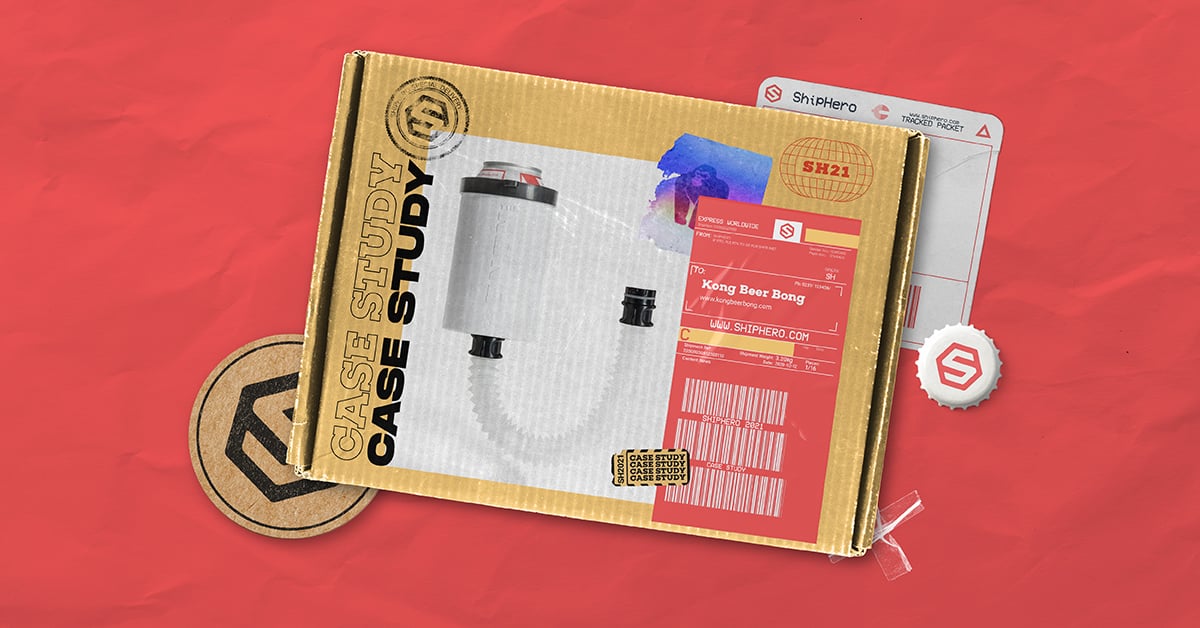
Like they teach in all MBA programs, sales and marketing is a lot like a beer bong. You need to have a large funnel to catch the liquid wherever it’s poured, you need to have a strong and sturdy pipeline that guides the beer to the final destination, and you need a way to properly and safely consume the beer.
No, this isn’t a frat guy’s dissertation; this is the story of how our customer Kong Beer Bong developed a strong product, sales pipeline and supply chain to grow a successful company using ShipHero WMS.
“We were able to save about $60-70k a year by being able to shop carriers other than USPS.”
-- Chase Snowden, Head of Marketing and Sales, Kong Beer Bong.
Kong Beer Bong was invented in 2017 by its two founders, Tristan McIntire and Hunter Souders, two college students at The Ohio State University. The pair spent a year of their collegiate journey developing, designing and testing a prototype for the prodigal beer bong, a device so perfect for drinking beer that Sam Adams himself would blush. Not long after, Chase Snowden joined the team in 2019.
After a successful Kickstarter campaign, the website and first shipment of Kong Beer Bong launched in late 2020, and the incredible team landed $3M in sales in under one year. Like all great businesses, they knew it was time to scale their logistics to keep up with the growing demand, and that’s when they turned to ShipHero.
We sat down with Chase Snowden to hear more about their journey, and learn how they used ShipHero WMS to drastically reduce their shipping costs.

Chase, please provide a brief description of yourself and your business
Chase Snowden: “The Kong was invented back in 2017 by the two founders, Tristan and Hunter, while they were in college. The two of them spent the next year designing and prototyping the idea, and were finally able to bring it to life in 2019.
"I met Tristan in 2019, when we were both discovering the drop shipping business model, figuring out how to sell things online, and building an eCommerce business. We had some luck early on, building a website in the “baby” niche that sold a beanbag chair designed to help babies learn to sit up and gain core strength.
"During this time, Tristan found an investor that wanted to put some money behind Kong, which gave us the foundation to pursue growing that product and brand. We launched a Kickstarter in late 2019 so that we could raise some additional capital for the first production run of 3000 units.
"After this successful KS, the first shipment of Kong Beer Bongs landed in February of 2020, and we subsequently launched kongbeerbong.com. Immediately, the results from our FB ads and Instagram shoutouts were amazing, which all lead to us achieving $3M in sales in the first 12 months."
Sheeeeeeeeeesh. So, what was your fulfillment model before switching to ShipHero?
“Before switching to ShipHero, we used a website called Pirateship.com to process all of the orders. Being a brand with a core hero product and some accessories allowed us to process orders relatively fast because we could buy labels in Bulk and process thousands of orders at once.”
And what was the moment you knew it was time for a switch?
“We wanted to transition to DHL eCommerce and away from USPS. Pirateship only supports purchasing USPS rates, and it also won't integrate with Amazon, one of our most recent sales channels.
"We also absolutely needed a bulk processing feature. Almost every platform only allows shippers to process orders First In First Out, and it will only let the user try to group orders together by writing different filters based on SKU and quantity of SKU.
"Grouping orders together was something that Pirateship did automatically, so that was the main feature we were looking for when transitioning.”
Why did you choose ShipHero?
“Bulk Ship - period. Not to mention, integration was super easy and painless. A few calls with Mike and the onboarding team and we were set up to start printing labels.”
What advantages have you seen since switching to ShipHero?
“We were able to save about $60-70k a year by being able to shop carriers other than USPS.”
Follow Chase, Tristan, Hunter, and Kong Beer Bong on social media and check out their websites below.
https://www.facebook.com/KongBeerBong/
Want to be featured in our case study?
If you would like to share with us stories about your eCommerce experiences, whether it’s how you started your business, what opinions you have on the stories we share, or if you just feel like venting… we’re here for you.
Shoot us an email and you could be featured on an upcoming Case Study, our critically-acclaimed weekly news segment The Packet, or if you’re lucky, you could be invited to join one of our many Podcast episodes!
Every Friday for the past 5 months, a chosen lot of lucky subscribers have received The Packet email newsletter of top e-commerce news and headlines. Together we’ve laughed, cried, and learned. But most importantly, laughed. Now, we’re expanding our audience to all of you!
The Packet’s mission is to get people excited about the world around them, with a focus on spicing up the e-commerce and logistics industry. There are so many stories to share about people who create, people who build, and people who lead. The Packet is your weekly bite-sized chunks of news so you can feel more knowledgeable and confident in the world around you, and also have something to talk about whenever dinner parties are a thing again.
With all the sources of news and information out there, who has time to parse through and find truly meaningful content while also trying to grasp whatever the author is saying (or paid to say). The Packet is free, fun and formulated out of love for the e-commerce and logistics industry. No ads, no sponsored segments, completely unbiased, and we love poking fun at Daddy Bezos. (It’s like the Skimm but sometimes funny)
Like a Friend’s montage episode, let’s roll some top stories from weeks past. If you like what you see, join our community of Packeteers every Friday by subscribing here. And be sure to join the conversation on Facebook, Instagram, Twitter, and Youtube.
After tireless digging and tugging, the mega-ton blockage that has been constipating global trade for the past six days has finally been cleared from the Suez Canal. The global trade community has given a collective sigh of relief as vessels are now starting to pass through.
Besides a lack of fiber (kidding), a seasonal dust storm, known as the khamsin, blowing winds at 40 knots caused the Ever Given to veer too far right and become embedded in the canal wall. While this is the story for now, navigation experts and engineers at the Suez Canal Authority are investigating the crash for technical and human error — this could have massive insurance implications and lawsuits if a responsible party is identified.
A full moon emerged (you can’t make this up) and brought in a high tide that buoyed the engineers efforts to refloat the ship. If this attempt failed, the tide would have fallen and they would have been forced to spend weeks unloading thousands of containers to help the Ever Given sit higher in the water. In total, hundreds of thousands of cubic feet of sand were removed.
Shipping operators estimate $12 billion of cargo is stranded along the 120-mile canal or idling outside it. Other shipping operators have already re-routed ships around the Cape of Good Hope, adding weeks and fuel consumption to the voyage. Experts estimate that this will result in another jam once all the vessels reach their destination at the same time, and over 360 vessels are waiting to pass through the canal. As a result, shipping and oil prices have risen, and the already beleaguered logistics industry will likely face additional delays and costs.This post has been sponsored by: MiraLAX. Blockage in your canal? MiraLAX.”
Walmart announced that they will be repurposing one North Dallas location into a fulfillment center dedicated entirely to online delivery and curbside pickup, with no more in-store shopping. As a proverbial canary in the low-price coal mine, this could signal a permanent shift towards local delivery and curbside pickup over conventional brick-and-mortar shopping.
Tired of sharing your beer with your dog? Busch Beer has announced a contest to hire a doggo “Chief Tasting Officer” for its popular Busch Dog Brew, and the winner could take home $20,000! To enter, post a picture of your pooch on social media with the hashtag #BuschCTOcontest… so animal services can come pick them up. JK sounds fun, good luck.
For the entrepreneurs who like to stay on top of trends, for the curious who love to have a global world view, and for the intellectuals who live on the edge of levity, The Packet is for you.

A dollar now is worth more than a dollar tomorrow. That’s the underlying principle behind some of our greatest financial instruments, such as interest rates, credit, loans, and even insurance.
Today, we see companies that allow customers to “buy now, pay later” are experiencing increased online sales and reduced cat abandonments by offering more flexible payment options. Customers are also more likely to purchase high priced items when they can split up the payments and pay them off over time.
You may have seen it through Amazon checkout, Paypal or Apple Pay, where you can select to pay an amount over the course of 4 payments (i.e., the Pay in 4) with no interest payment. This allows you to work solely with your trusted payment provider instead of opening a line of credit with a company.
But what is the Buy Now, Pay Later payment method? Should your business offer this? Let’s dive in.
Finance technology has reimagined the concept of layaway -- putting something on layaway means a retailer would let a customer pay in installments, and finally take home the item when the debt was paid in full. Now, customers can receive the product while they pay off their interest-free loan using the “Buy Now, Pay Later” payment method.
Yes it is still a loan, but consider it a micro-loan where companies like PayPal vouch for you to pay the installments in exchange for a small transaction fee to the merchant. The two types of Buy Now, Pay Later loans are:
This point-of-sale loan charges the merchant a transaction fee, and offers the customer a loan at no interest. Examples include payment methods offered by Klarna, Splitit or AfterPay.
Is this for my business? This type of loan is typically offered by larger merchants whose margins can absorb the transaction fee for the sake of vastly decreasing cart abandonments and increasing order volumes.
Conversely, this point-of-sale loan is offered to a customer by a third-party with a contractual down payment and interest rate, whereas the merchant pays no fee. The customer can receive the item immediately, but must pay installments plus interest.
Is this for my business? This type of loan is typically offered by retailers with higher value items. Because potential loss is more detrimental to a business with high value items, loan companies charge customers an interest rate for the increased risk.
The customer benefits for offering Pay Later services include:
Customers are more likely to purchase items when the payments are spread out over time. With tight budgets, customers would still be able to purchase an item even if they don’t have the money at the time of purchase, as long as they are confident that they will be able to pay the bill over the course of the month.
Given some countries reliance on credit (e.g., United States), a customer would be especially more likely to purchase higher priced items when the payments are split into reduced sums.
Not to mention, if you are the first of your competition to offer Buy Now, Pay Later services, this could become a competitive advantage and attract more customers to your brand.
According to recent studies, 6% of cart abandonments are caused by a lack of payment options. If your website has high traffic volume, this could spell thousands of dollars in lost revenue. In today’s realm of e-commerce, your shopper journey must have every consideration in mind. Offering more flexible payment options allows you to stay competitive.
This also simplifies the checkout process, because customers don’t have to enter their card details or billing information; instead, they just need to log in with their payment provider (e.g., PayPal, Klarna, etc.). By logging into a payment provider, customers may also feel more secure about not having to share their personal data with the company.
Buy Now Pay Later fits seamlessly into your product return experience. While many customers are not able to sample or try products, they can now take your products for a test drive without committing financially. This simplifies back-end accounting and budgeting.
You can affiliate with an app that offers “buy now, pay later” services, like the free Klarna application that offers Pay in 4 options, partners with global retailers, and offers reward programs for users.
You can also integrate your checkout process with a Buy Now, Pay Later service. According to G2, the top Buy Now, Pay Later services are:
The Buy Now, Pay Later payment method gives customers flexibility, and allows merchants to offset risks and protect themselves from loss in the process. The Buy Now, Pay Later method increases customers’ likelihood of purchasing items, especially those of higher value. If your competition is already using this option, it may be a good time to look into it for your business.
Providing customers with fast shipping options is vital to success, but for items on the heavier side, this can end up costing you an arm and a leg. Small packages? Those are easy to ship, and major carriers often give you nice discounts on them. But what about the big stuff?
When it comes to the shipping process, big carriers have come prepared to efficiently manage the logistics of oversized shipping. USPS and FedEx can even have heavy items delivered by the next business day. But at what cost?
Well, there’s a blueprint that you can follow to cut heavy package shipping costs down significantly and avoid unwanted expenses. If you trim the costs down from all around, the result is noticeable savings.
The right packing method ensures the safety of your large items. Here are four shipping strategies for oversized products:
Naturally, heavier and larger items need sturdier boxes. Always use new boxes when shipping large items because secondhand boxes may have some wear and tear on them.
If you can’t find double-walled or reinforced boxes, pack your original box in a larger box to add extra protection layers. Make sure to add extra cushioning with bubble wrap or packing peanuts between the boxes to minimize movement during transit.
Don’t be cheap by using duct tape or masking tape. When sealing boxes containing large objects, always use heavy-duty packing tape to seal every seam of your box so it won’t break open.
Oversized shipping can be expensive, so calculate your package’s weight, length and girth before going to the mail carrier. Once you have the package’s dimensions, you can calculate a shipping estimate and know how much money to prepare.
Sometimes, sending your items in several boxes is cheaper than sending all of them in one box, even if there’s only one recipient. Consider dividing your shipment if the cost of shipping several boxes at once is cheaper than sending all the items in one box.
When it comes to shipping heavy items and figuring out how to cut costs, you first need to ask, what am I being charged for? Knowing what factors count towards the shipping rates helps you direct your attention towards trimming these costs.
The concept of dimensional weight was introduced around 2015, and it differs from your package’s actual weight. Dimensional weight is a theoretical weight that factors into your package’s dimensions. Shipping companies adopted this model because they lost money on large packages that weighed less.
How does this concern you? Well, when your shipping partner calculates the shipping fees, they will take the greater of the two weights – dimensional or actual – into account. If your package weighs less than its dimensional weight, that’s what you’ll be charged for – so this is important to look into beforehand.
If the goods you are having delivered are damaged during the shipping process, then that’s going to send your costs sky-high. Damaged goods mean expensive returns and refunds, which you really want to avoid. So if you’re looking to ship items that need extra care, find a carrier that offers commendable fragile shipping services.
Big or small, the shipping fees you pay on a package will always incorporate the shipping zone into the calculation. This means that if the package travels a long distance to reach the customer, it will cost you more.
How can you cut these costs down? Opt for a distributed inventory! You can dramatically reduce shipping costs with distributed fulfillment centers in strategic locations.
The shipping costs you pay also depend on which carrier you’re using. Some are more generous when it comes to shipping oversized or fragile items, while others aren’t so much.
Shipping fees also depend on the shipping services you’re going for. Is it a 2-day delivery? Is it next-day delivery? Does the product need to be shipped internationally? Also, the price increment for shipping zones varies with the type of service. So, your zone-to-zone shipping fees for 2-day delivery may not increase as much as for overnight delivery.
As a small business owner, shipping large items can be expensive. Here are some top tips to try the next time you’re sending oversized products:
Heavier packages are more expensive to ship. While you can’t reduce your product’s weight, you can use lighter packaging to cut shipping costs.
Some good ways to reduce package weight are:
Reducing your package weight may only save you a few cents per package, but the savings add up, and you’ll save hundreds of dollars in the long run.
Many businesses adopt a one-size-fits-all approach to packaging, where they buy a lot of big boxes and use them to ship everything. While convenient, using large boxes to ship small products means paying more because of the bigger packages.
Instead of adopting a one-size-fits-all approach, you can buy several types of boxes that perfectly fit all your products and use them appropriately. This approach cuts down your average package size, meaning you’ll save on shipping costs.
Flat-rate shipping means the delivery cost is always the same, regardless of the package’s dimensions. If you can get a reasonable flat-rate shipping cost, you don’t have to worry about selling oversized products anymore because you’ll be charged the same regardless of package size.
If your business sells locally, you can provide local delivery or curbside pickup to people in your area. Since you can assign staff to deliver products or have buyers come to pick their purchases up, you can reduce or even eliminate the cost of shipping.
Major carriers have their own prices and services for shipping heavy and oversized items; one carrier isn’t necessarily better than another across the board. You need to determine which carrier specifically offers you the best package for what you’re shipping.
Carriers such as USPS, UPS and FedEx provide services to small businesses and even individuals, so they put their prices up in the open for you to see easily. But freight carriers such as DHL and FedEx freight that focus on serving large businesses don’t have their prices up publicly, so you need to contact them for a quote.
Here are some things to consider when choosing a carrier to ship oversized items:
Many carriers offer large item shipping solutions for your business, but each offers different benefits. Here, we look at three of the best large item shipping companies available today:
The United States Postal Service (USPS) is the largest carrier, so it should be no surprise that they offer pretty diverse shipping solutions to cater to different needs.
The USPS Priority Mail option is available for items that weigh 70 pounds and under, and the packages range from small envelopes to large boxes of around 1 ft x 1ft x 6 inches. If you’re looking to send a heavy item that is small or medium-sized in a reasonable amount of time, then the Priority Mail option is a good choice. While it’s not the fastest option, the delivery service gets the items to your customers within 1-3 days, which is great.
The Priority Mail Express is USPS’s fastest shipping option, where orders are guaranteed to reach your customers by the next business day. For packages under 70 pounds, the Priority Mail Express option is good if you can fit the item into the flat rate shipping envelope. Otherwise, the prices are pretty high for larger packages, and you might be better off with a different carrier.
Media Mail is a niche-specific shipping option from which select eCommerce businesses can benefit massively. With Media Mail, media items such as CDs, DVDs and books can be shipped at extremely affordable rates – the best rates you’ll find. So if you’ve got some heavy media items that need to be delivered, Media Mail is your best bet.
If your package is too big to fit in the Priority Mail flat rate box, then enter the Ground shipping option. This option still limits you to 70 pounds, but the size limits are less restrictive.
As you can see, the trade-off is that Ground shipping is a lot slower than Priority Mail. The prices are calculated depending on the shipping zone and weight.
Since we’re discussing major carriers, it should be no surprise that FedEx made it to the list.
FedEx doesn’t offer you the same guaranteed speed options as USPS, but they make up for it by offering you more liberal weight options. Unlike USPS, which limits you to 70 pounds, FedEx is far more generous, giving you the option to ship items as heavy as 150 pounds. They’re also more relaxed about package sizes – letting you ship items as large as 108 inches long or 165 inches for length plus girth.
So if your items are too big or too heavy for USPS, then head on over to FedEx.
If you’re shipping heavy items in large volumes, FedEx’s Freight option is one of the best picks. The prices vary immensely, depending on the product’s size and the shipping zone, but you’ll get an exceptional rate if you’re shipping a lot of oversized items.
Need international shipping taken care of effectively? Enter DHL, one of the best freight shipping carriers out there.
DHL’s Air freight option has your goods delivered through flights that are scheduled along major routes. The best part about the Air freight service is that there are many options to choose from depending on your needs.
Need door-to-door, airport-to-door, or door-to-airport delivery taken care of? DHL will manage all three. If speed is a priority, then Urgent Air Freight will have your delivery taken care of in just 1-2 business days. If you’re not in a rush, then Air Economy takes care of shipments within 5-7 days. If you have special cargo or temperature-sensitive items, DHL has options for those too, including delivering shipments in temperature-controlled environments.
Similar to the Air freight option, the Ocean freight service is great for shipping heavy items in bulk, except overseas rather than by air. The two main options are Full Container (FCL) and Less Than Container (LCL), but they offer special options for freight shipments like temperature-controlled environments and transportation facilities for liquids.
Our advice? If you’re looking to send big, bulky items in large quantities, then freight shipping is the way to go.
Before shipping large and heavy items, it’s important to ensure they are properly secured and in packages of the right dimensions. This involves using the right amount of dunnage where appropriate, and if you’re shipping fragile items, opt for something like bubble wrap to keep it safe. Large and heavy items are usually more costly, so you really can’t afford to have them damaged in shipping.
A package is considered ‘oversized’ when it’s either too large, too heavy, or a combination of both. Carriers traditionally consider packages oversized if the item’s length and girth are greater than 165 inches, if the goods weigh more than 150lbs, or if the length is greater than 108 inches. However, many carriers now limit the combined length to 130 inches. Let’s see what each carrier considers ‘oversized.’
USPS classifies items as oversized if they have a length of 108 inches and no more than 130 inches combined length and girth. For this range, businesses pay a standard Parcel Select oversized fee which is reasonable. Beyond these dimensions, though, you’ll have to contact USPS for a specific quote. USPS specifies oversized items by dimensions but not weight.
UPS has three criteria for classifying an item as oversized; if its weight is more than 150lbs, if the length alone is more than 108 inches, or if the combined length and girth exceed 165 inches. If your package dimensions or weight fall under these conditions, then you will have to pay UPS’s Over Maximum Limits charges subject to DIM.
FedEx classifies items as oversized if the length exceeds 96 inches or 130 inches in length plus girth. Dimensional weight calculations apply to oversized product calculations, and there is a minimum 90lbs village weight charge too. While FedEx still lets you ship oversized products by ground, there is an oversized shipping charge of $90 per parcel. Also, during annual peak shipping times, an additional charge called the oversized peak surcharge ($37.5 per package) is applicable too. So, FedEx may not be the most cost-effective option.
DHL classifies an oversized item as one that exceeds 70kg (around 155lbs) in weight or has any one dimension that exceeds 120 cm (that’s 47.24 inches). So, for oversized classification, DHL considers all the dimensions rather than the length. The oversized package cost is $89, but they have different services available that you can contact them about.
When it comes to shipping your large or oversized items, there are two things to prioritize; 1) keep the shipping fee as low as possible and 2) minimize the risk of damage. The steps themselves are quite straightforward:
This goes without saying, but we’ll mention it anyway – make sure that your items are secured in place and with great care.
Remember how we discussed the dimensional weight pricing model earlier? Well, when getting your items ready for shipping, look for the most efficient packaging option. This will not only help you score a lower shipping fee but is also important for keeping the goods safe. If your package dimensions are off relative to the items inside, then they might get tossed around during shipping and consequently damaged.
Weigh your package beforehand so you know exactly what pricing options it falls under. Is your package too heavy to be shipped by USPS’s conventional options, for example? Weighing your package is an important part of determining the right carrier and shipping option.
Calculate the rates that you will have to pay depending on the options available to you. Can you afford to go for the express options, or will that cut your profit margins down? Is one carrier giving you a better rate for your product’s dimensions?
Now that you’ve worked out which option is best for shipping your package, go ahead and book it!
Print your shipping labels out and fill the required details in – where is the package going to, how much does it weigh, etc. Different carriers have different shipping labels, so fill them in as required.
Put the labels on your package so that they’re ready to go!
All that’s left now is to send your package and wait for your customers to receive it. Hit the go button!
Heavy item fulfillment can be quite tedious, and not every business is equipped to manage oversized shipping efficiently. There are so many factors involved – calculating the weight, comparing weight vs dimensional weight, getting the right package sizes, figuring out which categories your packages fall under and more. So if this all seems too much for you, consider outsourcing the load to a competent third-party logistics partner.
ShipHero is a powerful warehouse management solution that many leading third-party logistics providers rely on. ShipHero also offers eCommerce merchants outsourced fulfillment options – we’ll take the hassle of heavy item fulfillment off your hands and perform all the calculations and leg work for you.
Remember how shipping zones were a big factor in calculating shipping fees and how a distributed inventory can help combat this problem? Well, ShipHero has you covered here too. Don’t have your own distributed fulfillment centers? That’s fine; you can have your inventory distributed amongst our own, ultimately reducing shipping distances.
An experienced logistics partner like ShipHero can help you make major savings on oversized shipping costs. With distributed fulfillment centers cutting delivery times and shipping costs down, powerful software solutions and an experienced team handling the technical stuff, ShipHero is the logistics solution that can help you slash unnecessary costs.
This depends on what carrier you are using. For example, FedEx considers a 100 lbs package oversized, so a $90 oversized fee will apply. However, carriers like DHL and FedEx may not consider this package oversized, so that shipping costs will be lower.
There is no single cheapest way to ship heavy items. Many factors come into play, including the package dimensions, package weight, dimensional weight, the type of items and whether or not you have a distributed inventory. A reliable logistics solution partner can help you find the most cost-effective way to ship heavy items.
To ship heavy items cheaply, you need to reduce as much weight as you can. That’s why large items must be properly packaged in boxes, parcels or containers of the right dimensions. The packages need to be weighed and measured so that you can determine the most cost-effective way to have them delivered. Correctly labeling packages before shipping them off is vital to make sure they reach the right destination.
This depends on many factors, including the carrier, the shipping option you are using and where the box is going. For example, let’s look at USPS’s Parcel Select Ground option, which is one of the slowest and most cost-effective delivery options. The 25-pound box can cost anywhere from $25 to above $70, depending on the shipping zone it’s headed.
Shipping heavy and oversized items involves far more complications than you might have imagined. The worst part is that if you don’t take the time to perform the necessary calculations and consider all the important factors, your business may incur significant losses. You're all set if you have a dedicated team with a skill set that can optimize your heavy item fulfillment.
If oversized shipping seems daunting and beyond what your business can comfortably handle, look no further than ShipHero. Outsourcing your fulfillment process to us means that we’ll work all the technicalities out for you, and find the most cost-effective way to ship your heavy and oversized products.
-
About ShipHero: We make it simple for you to deliver your eCommerce. Our software helps you run your warehouse, and our outsourced shipping solutions eliminate the hassle of getting your products to your customers. With over 5,000 brands and 3PLs relying on us daily, we’re here to help with all your logistics needs.
Let us know how we can help you today by scheduling a call HERE.
It’s official, Harry and Megan have left-- what? Oh, the other Brexit? Okay, take 2.
It’s official, as of January 1, 2021, e-commerce businesses that ship products to and from the United Kingdom must comply with a slew of new regulations, customs requirements and duties.
Failure to comply could land you with royal consequences like products blocked at customs, surprise fees and fines, and frustrated customers that never got their product or paid unexpected customs fees
If you can wait until July 1, 2021, they’re changing the trade rules to make it easier for e-commerce businesses to comply with the customs rules.
In this article, we’ll dive into Brexit’s overall effect on your business operations, and the 4 things you need to know when shipping to and from the UK. Also, be sure to check out the Brexit Checker for a personalized checklist.
Want the good news or the bad news? Let’s start with the good news:
Experts predict that, like Boris Johnson on a diet, the British £ will drop, causing products from the UK to become more affordable for international consumers, and thereby increase exports of British goods. Okay, to the bad news...
Supply chains are expected to struggle during the transition period, as all relevant parties adjust to new protocols and custom clearances. This is expected to cause significantly slower delivery times and increased product loss/damage in transit, because the more hands involved, the more likelihood for human error. And finally, le pièce de résistance…
When shipping into or out of the UK, additional tariffs on goods will either eat into your margins, cost your customers, or a bit of both. Not to mention, because the customs landscape is complex and varies by state, giving your customers clear custom fees is hardly possible, until July 1, 2021. As a silver lining, customs duties could encourage more local consumerism in the UK.
Here are the four logistics-related tasks to consider on your journey towards compliance with UK’s new trade rules:
A VAT number is a value-added tax identification number, and you need one to conduct business in the EU and the UK. The only way to get a VAT number is to register with a country’s tax authority.
UK sellers need to register with each country in which they sell. On July 1, 2021, this requirement goes away with the one-stop-shop rules. Due to the added complexity and increased tariffs, some UK sellers are finding it financially beneficial to move a portion of their inventory to EU warehouses.
EU, US and other country sellers that ship orders to the UK below £135 need to register their business for a VAT with HM Revenue and Customs. Similarly to UK sellers storing inventory abroad, international sellers that conduct a large portion of business in the UK should consider moving inventory to UK warehouses to avoid tariffs and fees.w
Be sure to contact your country’s tax authority or a local tax professional to understand how VAT rules impact your business.
Regardless of where your company is based, clearing customs in the EU requires an Economic Operator Registration and Identification (EORI) number, which uniquely identifies an exporter for customs.
Now, you need an additional UK EORI -- register for your UK EORI with HM Revenue and Customs. Customs declarations could include the following information:
Additional tariffs will be implemented between the UK and EU, and there are two choices when deciding who pays the bill.
Delivered at Place (DAP): The customer pays any import costs, the seller is only responsible for shipping the product.
Delivered Duty Paid (DDP): The seller pays any and all import costs.
When making this decision, consider your margins and what your competition offers. You can consider building it into the product price, or even discounting the import cost on orders above a certain threshold (e.g., free shipping/import fees on orders over $50!)
In the case of product returns, customs and taxes can be refunded but asking for a refund from custom agencies is complex, so consider that when moving to the final step below.
When you have made your shipping decisions, be sure to update your shipping policy and your returns policy to set customer expectations.
Make it very transparent whether your business or the customer is responsible for paying applicable customs fees and import taxes. If you pay (DDP), you can advertise the coverage as a competitive advantage; conversely if the customer pays (DAP), the customer will not be upset when unexpected fees are assessed after checkout.
If your customer pays the cost of any duties and taxes, clarify whether the collected import taxes and duties can be refunded in the case of a product return. While it is possible to get a refund, you’ll have to go through shipping carriers who paid the custom agencies directly. Headaches ensue.
Navigating global e-commerce is tough, and Brexit has thrown yet another wrench into the machine. But as an entrepreneur, you’re used to solving problems by now, either on your own or leveraging your network. That’s where a trusted partner in global logistics and order fulfillment should come into play. Find someone with experience in navigating the increasingly complex global logistics landscape to get set up for success.
Since taking the reins of the prolific video game distributor back in January, Ryan Cohen, co-founder of online pet food company Chewy Inc, has made quick work of fast-tracking GameStop’s e-commerce capabilities. The company announced Monday that it will expand its fulfillment network with a 700,000 sq-ft facility on, you guessed it, the moon. Jk close though, it’s in York, Pennsylvania
"This facility is expected to be operational by the fourth quarter of 2021 and will support e-commerce and fulfillment needs," the company said in a news release. "The Company expects its fulfillment center in York, Pennsylvania will position it to grow product offerings and expedite shipping across the east coast."
Beyond building out its fulfillment network, Cohen has ousted the former C-suite and ushered in a new team of current and former Amazon employees to support the transformation. Despite the recent stock market saga that captured the hearts of many Reddit users, the GameStop brand remains strong in the video game space, and this switch could further bolster the companies earnings. In fact, GameStop recently reported that its global e-commerce sales surged 175%, representing 34% of net sales in the fourth quarter of fiscal 2020.
Even before the pandemic, it seemed that physical brick-and-mortar retail stores were a thing of the past and soon to be outdated. The yearlong lockdowns may have expedited things a bit, but the reality was/is that retailers were scrambling to find a way to utilize their large real estate footprint.
Stores like GamStop are uniquely positioned to turn their retail stores in micro-distribution centers for fast and inexpensive local delivery. And other brands are starting to do the same, as ShipHero COO Maggie Barnett explains in an interview with Vogue Business.
"Some of our large beauty and fashion brands have a prolific real estate footprint, so they want to leverage that — even if people aren't necessarily visiting those stores at 100 percent capacity," Barnett says.
Check out the full article here.
On Wednesday, Trump-era rules were nullified that made it more difficult for a gig worker to be classified as an employee under federal law. When a gig worker is classified as an employee, they are covered by federal minimum-wage and overtime laws. It also means that these workers are better positioned to organize into labor unions -- and creating union jobs has been a top priority for the Biden administration.
The eCommerce platform is looking into cryptocurrency as a payment option, as well as exploring the realm of non-fungible tokens (NFTs). And they say eBay is shady ????
Jeff Bezos is building a gigantic luxury yacht that's expected to be one of the best in the world - and he's adding a 'support yacht' with its own helipad. We get it, he’s single now. Bill Gates plans to get girls in attendance by pinging their newly implanted 4G chips in their arm. Moving on.

By moving a 200 year old boulder by about 7.5 feet, a farmer in Belgium accidentally re-routed the country’s border with France -- the stones were placed to mark the border after an 1820 treaty. Belgian authorities light-heartedly warn that the farmer may face criminal charges if he doesn’t return the slaaaaaaaaab.

ShipHero Case Study is back y’all and this time… it’s written with Anger! Jordi Anger that is, Cofounder Of E-commerce Xpress, an upstart 3PL that serves small to medium-sized businesses in South Queensland, Australie. All aboard the E-commerce Xpress!
“From memory, it would take about 4 of my staff about 4-5hrs to completely fulfill 200 orders. The week we went live with Shiphero we did the same amount in about 2 hours -- as of right now, even less.” Jordi Anger, CoFounder of E-commerce Xpress.
Shipping costs have a huge impact on your bottom line. Learning how to properly calculate shipping costs and find the best shipping discounts to help your margins and improve the customer experience. Stop overpaying for shipping today, with our latest blog post: Shipping Costs: Calculators, Discounts & More.

With the ecommerce industry growing rapidly, many things about the field have seen significant improvement in the past few years. Companies have been working to ensure a better customer experience with improved technology and better shipping options. Quick delivery times with low shipping costs are vital to optimize customer satisfaction levels. But how can you offer faster shipping times without compromising profits?
The topic of faster shipping brings us to expedited shipping and the advantages it offers over standard shipping services. Here’s what ecommerce retailers should know about the workings of expedited shipping.
Expedited shipping refers to shipments that are faster than the standard option for delivery. The actual term means different things for different carriers and can refer to one-day or two-day delivery options. As such, expedited shipping charges to domestic or international destinations vary with the various delivery services.
Different delivery options with various carriers usually come with their specific strategy for the whole supply chain. Depending on the type of product and the shipping zone distance between the point of origin and destination, the delivery times of expedited shipping can vary with each carrier.
The expedited service option usually comes with added cost for the lesser delivery times that increase with the shipping zone distance and the parcel's weight and dimensions. Some businesses hold customer satisfaction in high regard and feel that the expedited shipping option is worth it. Of course, faster delivery times add to the whole charm of the sale for the customer and can increase your company’s revenue.
Standard shipping usually costs the least when it comes to different delivery services. The standard service could translate to a two-day shipping time for some companies, while others might offer longer delivery times for their standard shipping. The standard delivery option for one of the most popular carriers in the US, the USPS, consists of ground shipping and usually takes more than two business days for farther shipping zones.
Expedited shipping provides a guarantee to your customers that their packages will be shipped in reduced transit times. This reduction in transit time directly increases customer satisfaction, and it is arguably one of the most important reasons businesses opt for this shipping method. However, there are other advantages to expedited shipping as well.
The primary purpose of expedited shipping is to save on shipping time. Carriers often do this by minimizing the supply chain to the final destination. If your customers are willing to pay more for faster shipping, expedited shipping is the suitable business method for your setup.
Many perishable items like frozen food and baked items require faster shipping so that the products do not expire during the shipping process. For this reason, expedited shipping is the correct answer for your business if you are involved with the food industry.
If most of your customers opt for faster shipping methods and are willing to pay the extra cost, then you should look into making expedited shipping into your standard shipping option. There is a chance that retailers might lose customers who want faster shipping if they don’t offer expedited shipping.
Taking the products from the manufacturers and storing the inventory in warehouses often comes with detailed storage charges. When you offer expedited shipping, the products spend less time in storage, and you can save on inventory storage costs.
Unsatisfactory delivery options directly link to cart abandonment among prospective customers. Having various shipping options such as expedited and standard shipping lets the customers choose the shipping option they like. Therefore, it’s wise to offer expedited services to your customers.
Customers usually look at a couple of retail options before buying something, and they often go with the retailer that provides convenient delivery options. Today, faster shipping methods like Amazon’s next-day delivery options have increased customer expectations, and this is why not having expedited shipping could hurt your sales.
Customer satisfaction is the key to getting repeat customers and building customer loyalty. When the customers get their parcels delivered faster, they are more likely to purchase from your shop again in the future. Offering expedited shipping options could enhance the customer loyalty in your consumer base and possibly secure future sales.
Different delivery services come with different standard and premium delivery times. Let’s look at some of the popular shipping options and how they fare compared with expedited shipping.
Standard shipping services are often the cheapest shipping option out there, but they also take many business days to deliver the package, depending on the shipping zone distance. On the other hand, expedited shipping offers reduced shipping times while being more costly. Some companies have two-day delivery as their standard shipping options, while others take longer in their standard delivery service. These options vary from company to company.
Depending on what carrier service you are looking at, expedited and express delivery can be used interchangeably or mean the same thing. Couriers usually have a variety of standard and premium delivery options, and these terms vary depending on their context of use.
For some companies like Amazon Prime, two-day shipping options are standard, while for others, two-day delivery often falls under the umbrella of expedited shipping. Like the other terms, these terms also vary with each courier.
Many carriers offer different expedited shipping services like flat-rate shipping, ground shipping, and next-day air shipping options. Let’s look at some of the most popular carriers in the US and their expedited shipping services.
USPS is among the most popular courier services in the US for domestic delivery. A popular expedited shipping option by USPS is their Flat Rate Priority Mail Express. This mail service comes with options like overnight and next-day delivery options, and you can track the parcel during shipment.
UPS is another shipper that offers expedited shipping options for domestic delivery, including same-day, next-day, and two-day shipping guarantees. The UPS Worldwide Expedited service offers faster delivery to international destinations.
FedEx also provides several expedited shipping options based on the package’s size and dimensions, destination, and urgency. These shipping options include FedEx Express Saver, and FedEx Expedited Freight, and the FedEx Same Day service.
It might seem that expedited delivery is impossible for small businesses to offer and might kill your budget. But there is a way to provide expedited delivery without any extra burden on your budget - and here's how.
Having your inventory stored in multiple fulfillment centers means that you can minimize the shipping zone distance from the warehouse to the destination. This way, you can use ground shipping methods from the nearest warehouse for the expedited shipping option.
To cover the shipping costs for expedited shipping, a smart thing to do is set a minimum order purchase threshold. This way, you can cover the marginal shipping cost from the products' revenue while keeping your customers happy.
Another way to save on shipping costs is to work with an experienced third-party logistics (3PL) company that can get you discounted shipping rates with major carriers. Other than the discounted shipping rates, a 3PL can help cut back on shipping costs by making the process more efficient. Experienced 3PL partners offer shipping options and technology that you might not have been able to manage on your own.
By now, you understand the importance of expedited delivery and why it pays off to offer your customers multiple shipping options. With ShipHero, you can offer different types of expedited-delivery options like overnight or two-day delivery services, depending on your customers' needs and your company’s budget.
ShipHero partners up with 3PL companies to offer you discounted shipping rates and distributed fulfillment options so that you can reduce shipping times and shipping rates in one go.
ShipHero lets you distribute your inventory across the nationwide network of fulfillment centers. Having distributed fulfillment centers all over the country means that you can minimize the shipping zone distance to the. What this means is that you can offer faster shipping to your customers with the help of on-ground shipping methods.
ShipHero offers you different courier services to partner up with, and some of them offer discounts on the shipping rates. This way, you can save on shipping costs and choose the carrier that works best for you. As a plus, there are no hidden shipping fees, and users get precisely what they pay for.
Expedited shipping sure has its advantages, but it can also seem like a very costly option. Now that you have looked at how you can realistically offer expedited shipping options to your customers without breaking the bank, it’s time to get things going. ShipHero lets you offer expedited shipping by connecting your ecommerce platform to trusted carriers with various shipping options and discounted rates.
If you're looking to provide customers with premium shipping options without breaking the bank, then check out ShipHero.
*Takes dramatic drag of cigarette* What does it mean to be in good company? In essence, it’s simply a group of people bonded together by common ideas and shared values. In a business sense, a company is only as good as the glue that holds it together, bonded through a shared mission, a vision to strive towards, and the belief that the joint effort of a company will result in prosperity well beyond the capacity of an individual.
So what happens when the frustrations start to mount, and your business is brought to the very brink of “do or die”. Well that’s what happened for E-Commerce Xpress, a third party logistics (3PL) provider located in South Queensland, Australia that specializes in guiding small to medium-sized businesses through the initial growth phase of logistics -- ranging from women’s apparel and winter clothing, to home gym equipment (booty bands, resistance bands, water bottles, etc).
>”Shipping 200 orders felt like such a struggle. Our staff definitely shared the frustration. To put it in perspective there was one fairly high volume period where in an 8 hour shift, someone tracked
12.5km on their Fitbit for the day.” E-Commerce Xpress Cofounder and GM12.5km … for those of us not on the metric system, that’s about one third of a marathon. After this particularly stressful event, the good people at E-Commerce Xpress decided it was time for a hero to sweep them off their aching feet -- a ShipHero that is. We were enticed by their story and sat down with Anger, Jordi Anger, Cofounder and GM of E-Commerce Xpress. Here’s our interview.
ShipHero: Mr. Anger, could you please calmly provide a brief description of your business :)
“We are very simply a 3PL/fulfillment centre located in South Queensland, Australia. We specialise in fulfillment and inventory management for small to medium-sized e-commerce brands who are going through those initial growth phases in the logistics side of their business.
The local brands are starting a lot of eco-friendly, earth-conscious based products/brands, and we also see a lot of Swimwear and Cosmetic type business, probably due to the renowned sunny weather we have here!
Our goal is purely to ensure that their customers have the best possible journey behind the 'Pay Now' button and provide the best and most flexible service possible for our clients.”
Before switching to ShipHero, what were the challenges that made you want to just rip your hair out?
“We were using another 3PL company, which initially sounded like the best suit for us at the time. Unfortunately, the transparency was not there and by the time we had switched to live we found that we couldn't use their product to its fullest potential. "
As a result we had to go pay for a completely separate platform just to be able to generate labels and ship orders. So we couldn't pick Multi-batch, we had to become a paper reliant warehouse, we couldn't fulfill orders through the one system and we had next to no support, which are all the things we were initially sold on.
The main frustration was that--”
Uh oh.
“Anyway, the main frustration was that because of this, the time it took to ship 200 orders for example was ridiculous. From memory it would take about 4 of my staff about 4-5 hours to completely fulfill 200 orders. My staff definitely shared the frustration. "
To put it in perspective there was one fairly high volume period where in an 8 hour shift, someone tracked 12.5km on their Fitbit for the day. This was simply because the walk-time they had to do for each order was essentially the same each time due to not being able to use the multi-batch order feature."
And… how did that make you feel?
“Agitated”.
Phew. How about after the switch to ShipHero?
“The week we went live with ShipHero we did the same amount [200 orders] in about 2 hours. As of right now, even less. After the switch, the amount of efficiency we were operating at was, and still is, truly amazing. That would be our biggest area of improvement, along with now becoming a paperless warehouse which is really important to us.
"The only way this is possible is by partnering with a platform that had similar values like ShipHero. We see ShipHero as an extension of our team as well, and so far they haven't let us down.”
Ha … we’re honestly terrified to let you down. So when searching for a fulfillment partner, what did you consider as important criteria?
“Customer service is always a must! In this industry, it's very common for small issues to arise every day so we needed to make sure we had a really good support team by our side, and more importantly, an on-boarding team that could teach us to problem-solve ourselves!
"We also wanted a modern and easy to navigate interface that would be simple for our employees to learn as well as our clients. There are a lot of outdated WMS that we came across that are really hard to grasp.
"Finally, cost is an obvious factor. There are a lot of services out there that have a lot of hidden fees that once you start operating, it's clear that those services are necessary.”
What made you finally choose ShipHero?
“Liam Dillon (CoFounder) and I had been watching and sharing some of ShipHero's YouTube videos and really liked how they were explaining and demonstrating the pick-and-pack processes. We decided to do a bit more research on ShipHero and found that they have a 3PL-specific WMS platform.
"We had already had multiple meetings with other platforms but none were the right fit. ShipHero stood out to us immediately as we could see that they weren't 'stuck in the past', and really provided a fun and modern aspect to 3PL and fulfilment.
"Not to mention, the pricing structure was super easy to understand and really cost efficient, which was a huge plus!”
How was the integration process with ShipHero?
“Our last WMS had a 6 week on-boarding period to get set up and learn the system, with ShipHero we were integrated in about 2 hours! This experience was super straightforward and easy.
"We essentially went live the next day after connecting our customers, and we were shipping immediately. It was the best way to learn the system as we essentially jumped straight in and learned by doing. Everyday, our onboarding manager was checking-in to see how things were going and was available via email, phone and even SMS.”
Well don’t forget that they’re still around for whenever you need to manage your ... systems. Finally, how was your business impacted by COVID-19?
“We strangely launched our business throughout the COVID-19 period. We were pretty lucky here in our state that we were able to control the cases and still be able to provide essential work for the most part!
"We were also super lucky to have two amazing clients that saw the benefit in utilizing our services throughout COVID-19 as their industry skyrocketed during this period. Liam already had a really good relationship with them previously so we were able to help them control their growth and provide an awesome service whilst they allowed us to grow with them and quickly build our operations into what it is today!”
Amazing. Final thoughts, comments, words of praise, or outbursts?
“In summary, we are super lucky to be able to partner with ShipHero, who is focused on continually making changes to benefit their users! I feel like every month there are new and updated features which might not seem like a big deal but benefit our warehouse processes dramatically.
"We have been able to scale back our costs, time and effort ever since partnering with ShipHero, which at the end of the day has allowed us to focus on growth and perfecting our business' services and operations.”
Follow Liam and Jordi and hop on the E-Commerce Xpress at their website and Facebook.
https://www.facebook.com/E-commerce-Xpress-107514591393563
https://www.instagram.com/ecommercexpress_/
Want to be featured in our case study?
If you would like to share with us stories about your eCommerce experiences, whether it’s how you started your business, what opinions you have on the stories we share, or if you just feel like venting… we’re here for you.
Shoot us an email and you could be featured on an upcoming Case Study, our critically-acclaimed weekly news segment The Packet, or if you’re lucky, you could be invited to join one of our many Podcast episodes!
With the ecommerce industry booming and competition increasing every day, customers have increased expectations about the online shopping experience and the order fulfillment process.Of course, platforms like Amazon set the bar for both ecommerce merchants and couriers alike with their impressive overnight and 2-day shipping policies. For small businesses, pulling off quick delivery times can put a lot of pressure on your logistics operations. Unless you have a network of fulfillment centers and a big labor force, fulfilling orders to get delivered in a cost-effective manner is going to be tough.
So, how can you manage shipping costs to profitably ship orders and not lose sales to major brands? This article will take you through the basics of shipping costs and how you can correctly estimate them through different factors and tools.
The total shipping costs depend on the basic information of the package that you’re shipping and on the declared value of the products inside. However, the total cost often depends on many other complex factors as well. Here are a few factors that contribute to the shipping rates that popular courier services offer.
The package dimensions, such as length, width, and height, are usually multiplied together to calculate the dimensional or volumetric weight of the package. The size of the package usually determines the shipping rate per cubic foot and different box sizes are marked with different shipping costs.
If the actual weight of the package outweighs the dimensional weight calculated from the standard formula, then the actual weight of the package is used as the billable weight and the shipping costs are based on that. Thus, the larger the package is, the higher its shipping costs.
Additionally, the shipping costs depend on the destination country and the destination zip codes. For some zones, the shipping costs are usually higher. Like in the United States, shipments to Hawaii and Alaska are often more expensive than in the continental states. The total costs depend on the zone distance which is calculated by counting the shipping zones between the point of origin and the destination.
Often, packages with a high declared value require shipping insurance. This is also true for expensive products and dangerous goods that require their own packaging to be shipped in that isn’t standard. The parcel handling-related charges add to the shipping-related charges, resulting in higher shipping costs in total.
For most couriers, premium and fast shipping get more expensive the more zone distance there is to cover. For example, overnight shipping in the same zone might not be as expensive as overnight shipping to some destinations five zones away, as that would probably require air shipment for fast shipping. The standard post delivery to the same destination might cost less but it would take longer for it to be shipped.
The above-mentioned factors are usually what popular shippers use to estimate shipping costs. Many ecommerce platforms have their own shipping calculator, like the Shopify shipping calculator that gives instant shipping quotes for a package. Let’s take a look at some of the carriers.
USPS is among the cheapest carriers in the USA, especially for ground shipping. The post office sends daily rounds for shipments and this is the reason that USPS offers fast deliveries at such modest rates, making it one of the best deals out there.
USPS offers a variety of deals based on the mail classes like priority mail, flat-rate shipping with envelopes and different boxes, etc.You can use the USPS Shipping calculator to get shipping quotes from the courier on domestic/APO/FPO and international shipping.
FedEx is another popular carrier service in the US and Canada. FedEx offers a variety of delivery deals ranging from same day to overnight shipping, and from ground to air shipment.
The FedEx Small Business program offers shipping solutions to small businesses and the rewards program offers shipping discounts. FedEx shipping costs are based on the dimensional weight of the packages.
You can check the FedEx shipping cost calculator on their website to estimate shipment charges.
UPS is another popular courier service in the United States. UPS shipment ranges from the UPS ground to UPS 3-Day Select or 2nd Day Air. UPS prices, like that of FedEx, are also based on the dimensional weight of packages. Small businesses can often cash in on some shipping discounts through the UPS Connect program, which apply to both ground and air shipments.
The UPS shipping calculator can be found on their website.
By now, we’ve covered the basics of shipping charges and how they are calculated. In case you still have some questions about shipping cost calculation, here are some of the most frequently asked questions, answered.
The dimensional or dim weight is calculated by measuring the dimensions of the package and then dividing the total volume by a standard dim divisor. Popular shipping carriers like USPS, FedEx, UPS, and DHL, etc. base their shipping rates on the dimensional weight of the package.
Yes, USPS has many offers for flat rate shipping where you can ship by putting your products in the standard flat-rate envelopes or the flat rate boxes in sizes small, medium, and large.
Shipping costs on USPS can be easily calculated through the shipping calculator available on their website. You can use the drop-down menu available on the website to estimate the shipping cost of the different shipping label deals offered by USPS.
Usually, third-party logistics companies have set deals with shipping carriers like USPS, UPS, and FedEx, etc. By using the services of a 3PL provider, you can often get shipping discounts through these couriers. Just sort out these details with your fulfillment provider.
One of the cheapest carriers is the United States Postal Service or the USPS for short. Comparing the average shipping costs for FedEx, USPS, and UPS, it is clear the USPS is the cheapest option for both ground and air shipments. USPS also offers many shipping services like the Retail Ground, Priority Mail 2-Day, and Priority Mail Express, etc. The actual shipping quotes are present on the USPS website.
By teaming up with third-party logistics companies (3PLs) for logistics and warehouse management services, small businesses can enjoy major savings on shipping costs. So, how exactly can you save on shipping costs by outsourcing your fulfillment, you ask? Let’s take a look!
Because 3PL companies manage order fulfillment for several clients and handle plenty of daily shipments, they often have agreements for discounted rates with carriers. This way, they can offer their clients discounted shipping rates as well. Most 3PLs don’t charge extra fees for the discounts, so you can rest assured that you won’t be charged extra for shipping with a 3PL.
Because of distributed inventory, ecommerce business owners can have inventory stored at different warehouses in different shipping zones. This makes fast shipping easier as the inventory can be sourced from the closest warehouse upon the placement of the order and the extra fuel charges can be avoided. Basically, orders will be sent to the warehouse closest to the customer to improve delivery speeds and reduce transportation costs.
Additionally, these fulfillment companies are often able to offer overnight and 2-day delivery options, thanks to the above-mentioned factors. This helps small businesses compete with Amazon and other large brands that have the fulfillment network capable of delivering orders quickly.
Shipping costs not only depend on the product you’re sending and where you’re sending it from, but also on where and how fast the goods are being sent. Additionally, the total costs also depend on what carrier you are partnering up with. The good thing is that these things can often be estimated to great accuracy with the help of internet tools.
To sum things up, shipping costs, while they seem simple enough, involve a lot of complex factors in their overall calculation, and you should definitely keep them in mind.
Get started with ShipHero’s fulfillment services to reduce shipping costs.




.svg)