
.svg)

Let’s stay in touch with the ShipHero Blog.


.webp)
The ShipHero Model Context Protocol (MCP) connects supported AI clients directly to your live ShipHero data, so warehouse teams can ask questions and get specific answers from their own account. It is built for day-to-day operational checks, including inventory levels, open orders, shipment status, holds, returns, purchase orders, and exceptions. For ShipHero customers, it is available at no additional charge and runs on existing API credits.
Every order, shipment, inventory movement, hold, return, and purchase order creates data inside ShipHero. Your warehouse information is right there, but getting to it can be a slow, complex process.
Before the ShipHero MCP, answering a specific operational question often meant logging in, finding the right report, applying the right filters, exporting data, or asking the one person on the team who knew where to look.
Even when the answer was simple, like a quick inventory check, it could turn into a 20 to 45 minute task. A customer question could sit half a day while someone pulled the right numbers. That delay adds friction to the floor. It slows decisions. It keeps teams waiting on data they already own.
The ShipHero MCP gives supported AI clients secure, read-only access to live ShipHero data.
That means operators can ask questions in plain English and get answers from their actual account, not from a generic help article or static knowledge base. A chatbot can tell you where to find a number. The ShipHero MCP can return the number itself.
It works with MCP-enabled AI clients, including Claude, ChatGPT, Cursor, and Codex. Connect it once, authenticate access, and your team can start asking operational questions from the AI tool they already use.
The workflow is simple:
The MCP does not replace ShipHero. It makes the data inside ShipHero easier to reach when your team needs a fast answer.
The ShipHero MCP is designed for everyday operational questions, such as:
If the data lives in your ShipHero account, the MCP gives your team a faster way to ask for it.
Speed matters, but safety matters too.
The ShipHero MCP is read-only by design. It can retrieve information from your account, but it cannot create orders, modify records, delete data, or change warehouse settings.
That gives teams a practical way to use AI for operational visibility without risking accidental account changes. Operators can ask. Managers can check. 3PL teams can answer client questions faster.
The data becomes easier to use, while the records stay protected.
For founders, the MCP can turn a quick inventory check into a simple question.
For operations leads, it can surface shipment status, holds, exceptions, and low-stock SKUs without digging through reports.
For 3PL operators, it can help answer client questions faster, using live account data instead of manual follow-up.
The result is a faster way to reach the information already inside ShipHero.
The ShipHero MCP is available to all ShipHero customers at no additional charge. It runs on existing API credits, so specific questions help keep usage efficient.
To get started, visit developer.shiphero.com or contact your ShipHero account representative.
ShipHero MCP is a read-only connection between supported AI clients and your live ShipHero data. It lets users ask operational questions in plain English and receive answers from their actual ShipHero account.
A chatbot usually answers from fixed, generic information. ShipHero MCP connects to live account data, so it can return specific answers about your orders, shipments, inventory, holds, returns, and other ShipHero records.
ShipHero MCP works with AI clients that support the Model Context Protocol, including Claude, ChatGPT, Cursor, and Codex.
No. ShipHero MCP is read-only. It can query data, but it cannot create, update, or delete records in your ShipHero account.
No. The MCP is built for operators and can be connected from a supported AI client in minutes. Developers may use more advanced tools for deeper analysis, but most day-to-day users can work directly with the MCP.
Yes. ShipHero MCP is available to ShipHero customers at no additional charge and runs on existing API credits.
Transitioning to a new Warehouse Management System (WMS) is a high-stakes decision that often triggers concerns regarding downtime, data integrity, and workforce adaptation. As warehouses prepare for 2026 growth, understanding these common hurdles—and the technical solutions that resolve them—is essential for a successful migration. This guide addresses the five primary barriers to adoption and how a high-velocity infrastructure ensures a seamless transition.
Warehouse operators frequently hesitate to upgrade due to perceived risks that can halt operations. These challenges typically include:
To clear these hurdles, a structured implementation strategy is used to prioritize data density and entity clarity.
In the competitive eCommerce landscape, staying stagnant with manual workarounds is often more costly than the transition itself. Moving to a high-velocity WMS converts your warehouse from a cost center into a growth engine by providing Labor Efficiency and ROI through automated routing and reduced authentication friction.
Because the platform is built for the floor worker, features like Workforce Hero allow seasonal temps and new staff to be authenticated and productive in under an hour.
No. High-velocity infrastructure increases visibility by providing Total Real-Time Control. Managers can monitor exactly what is in the Hospital queue and track replenishment in real-time from a single dashboard.
Before going live, a ground-up audit is performed using cycle counting tools. The system's architecture ensures that every movement on the floor is synchronized with sales channels instantly, maintaining 99.9% accuracy.
Picture a packer at Peak Season. A box is in front of them, a product in each hand, and somewhere on a cluttered desk there's a mouse they need to find to confirm the order. They look down. They hunt. They click. Then they do it again. Thousands of times a day.
That moment of friction is small. But it is never just one moment. Multiply it across your entire pack line, across an entire shift, and you are looking at a measurable and largely invisible drag on your total throughput.
Tap-to-Pack is a purpose-built hardware controller designed by ShipHero to eliminate digital friction at the packing station. It connects via USB-C, requires no drivers or additional software, and syncs automatically with the ShipHero WMS packing app. This new system is now available at the ShipHero Store.
Instead of navigating a screen with a keyboard and mouse, packers execute every high-frequency command — such as selecting box sizes, printing labels, finalizing orders, flagging exceptions — with a single physical tap on one of eight programmable buttons.
Key specifications:
Most warehouses are running 2026 operations on 1990s peripheral standards. The keyboard and mouse were designed for spreadsheets and emails, not high-volume fulfillment. When used at a packing station, they create three compounding problems:
The problem is not your people. It is the tools you are asking them to use.
Tap-to-Pack introduces a "Rodent-Free" packing standard: a workflow where the packer's hands stay on the product, their eyes stay on the work, and the software fades into the background.
The device guides the packer through two feedback systems:
ShipHero customers running Tap-to-Pack are already seeing a 90% reduction in on-screen interactions and a significant increase in the number of orders packed per hour, without adding headcount or changing their warehouse layout.
One of the hardest challenges in fulfillment is absorbing volume quickly, especially during Peak Season, when temporary staff need to reach target productivity fast.
Because Tap-to-Pack's interface is physical and intuitive, there is almost nothing to teach. Pick up the product, follow the light, tap the button. New packers can reach target productivity in minutes rather than hours.
The system is also modular:
Whether you are a growing DTC brand or a high-volume 3PL, Tap-to-Pack is designed so your hardware never becomes a ceiling on what your team can do.
Tap-to-Pack is a programmable, industrial-grade hardware controller that connects to the ShipHero WMS and allows warehouse packers to execute packing station commands, such as printing labels, selecting boxes, and completing orders. All with a single physical button press, eliminating the need for a keyboard and mouse.
The device connects via USB-C and syncs automatically with the ShipHero WMS packing app. It is a true plug-and-play solution: no drivers, no background software, and no manual configuration required.
Yes. Buttons are configurable for a range of packing actions, including Print Label, Complete Order, Select Box Size, and the Hospital function, which flags a problematic order and keeps the line moving without stopping to resolve it on screen.
The system is fully modular. Connect up to two additional 8-button hubs to the Main Hub for a total of 24 programmable buttons, supporting even the most complex multi-step packing workflows.
Tap-to-Pack devices require ShipHero Packing App v1.0 or higher. The current release is v1.1.0.
Imagine running a warehouse where orders are picked quickly, inventory is accurate, and all operations run smoothly without any errors or delays. Thanks to Artificial Intelligence, this can now become a reality with ease.
AI is transforming warehouse management by enhancing efficiency, intelligence, and the ability to meet the rapid demands of today’s eCommerce-driven market.
ShipHero is pioneering this revolution with its AI-powered warehouse solutions, setting new industry benchmarks. This article explores ShipHero’s AI Picking feature, highlighting how it’s transforming warehouse management and enhancing operational efficiency.
The integration of AI technologies, including machine learning, robotics, and predictive analytics, is revolutionizing warehouse operations, driving significant improvements in efficiency, accuracy, and overall performance. These innovations are optimizing processes across various areas, from inventory management to order fulfillment. Below are the key benefits of AI in warehouse management.
A combination of AI technologies is shaping smarter warehouse systems to help revolutionize warehouse management.
ShipHero has taken AI integration to the next level with its AI Picking feature, designed to significantly improve warehouse efficiency. This feature automates the picking process, reducing the reliance on manual labor and enhancing productivity in ways that were once thought impossible.
Let’s dive deeper into how ShipHero’s AI Picking works and the advantages it offers.
AI Picking optimizes warehouse operations in two key ways:
The AI Picking feature delivers a wide range of benefits:
The transformative power of AI extends far beyond just picking. AI is also revolutionizing other aspects of warehouse management, driving improvements in operational efficiency, inventory management, and safety.
AI automates tasks, reducing errors and increasing speed. Automated sorting and real-time inventory tracking ensure accuracy, while real-time monitoring helps managers adapt and ensure timely deliveries.
AI plays a vital role in maintaining accurate inventory levels. By leveraging predictive analytics, AI can forecast demand and optimize stock levels, helping warehouses avoid both stockouts and overstock situations. This leads to better inventory management and fewer disruptions in supply chains.
AI-driven systems can monitor warehouse conditions to ensure safety and compliance with industry regulations. These systems can analyze warehouse data and predict potential hazards before they occur, proactively reducing risks and ensuring a safer working environment.
AI technologies are playing a transformative role in the supply chain and logistics sectors by improving efficiency, reducing costs, and enhancing decision-making.
These intelligent systems effortlessly manage supply chain processes by using data to optimize operations, predict trends, and automate routine tasks. This ultimately reshapes everything, from how goods are moved to stored and delivered.
The future of warehouse management looks promising with greater automation and efficiency, but future warehouse digitization brings challenges, such as high upfront costs and the need for skilled personnel.
AI-powered drones, autonomous robots, and IoT integration are smart warehouse technologies that are revolutionizing warehouse operations. Drones will deliver goods quickly, while robots automate sorting and transportation, thereby reducing the need for manual labor.
IoT and AI integration will enable real-time monitoring and optimization of operations. Smart technology in warehouses is leading to fully automated systems that are faster, scalable, and need minimal human input.
While AI offers immense benefits, businesses must also consider certain challenges. High initial investments in AI technology, data security concerns, and the need for skilled personnel are just a few of the hurdles that must be addressed.
However, with a strategic approach, companies can eliminate the challenges and embrace AI’s full potential to boost accuracy in picking and improve overall warehouse operations.
AI minimizes error by automating tasks like inventory tracking, order picking, and sorting, ensuring greater accuracy and efficiency.
Yes, AI-driven predictive analytics can predict demand, track inventory levels, and improve supply chain efficiency by forecasting needs with greater accuracy to help businesses stay ahead of trends and market fluctuations.
AI solutions are becoming more cost-effective thanks to cloud-based services and subscription pricing models. These options make AI technology more accessible to small businesses, allowing them to take advantage of its benefits without large upfront costs.





It’s official! Returnly and ShipHero have teamed up, and ShipHero users have access to an exclusive deal. This breakthrough integration allows ShipHero users to offer an end-to-end product return experience. So, what does this mean for ShipHero users?
Returnly helps Shiphero users create a fully branded, self-serve return center, complete with all the necessary automation and policy controls to reduce operating costs and give customers all the options they want upfront.
Mistakes happen. If you ship the wrong order, send the right one immediately and Returnly will accept the risk of the customer actually returning the order. Returnly lets shoppers return or exchange items for a different size, color, or something new without contacting your business.If a shopper opts for a refund, Returnly offers an instant credit to shop your site while the return is processed. And when you save the sale, Returnly pays for the order so your customer gets the right item before returning the wrong one, completely risk free. This decreases your shipping time and increases the return experience for the customer.
ShipHero and Returnly seamlessly transfer data to manage and track the return process within ShipHero’s platform. This improved data integration with Returnly makes returns seamless for you and the customer, better positions you to convert returns into repurchases, and saves time and holiday revenue for your business.
To help you successfully navigate the upcoming return season, ShipHero has secured our customers access to an exclusive deal — two months free when you sign-up for a Returnly Premium plan before January 31, 2021.To learn more and claim your offer, click here.
.svg)

Objects! with ShipHero talks with the entrepreneurs, innovators and idealists that put items on the shelf and bring packages to your doorstep. From hot sauce to board games, toothbrushes to frying pans, startup side-gigs to enterprise players, join ShipHero founder, Nicholas Daniel-Richards, as he demystifies the manufacturing and logistics behind some of our most beloved household objects, with transformational ideas that are guaranteed to make you say, why didn’t I think of that?. This fast-paced and intriguing podcast covers thousands of travelled miles in less than an hour, so next time you’re standing in your local store and see a label that says ‘Made in <A Land Far, Far Away>’, you’ll know just how it got into your hands.
Objects! with ShipHero discusses in detail what it takes to transform an intangible idea into a tangible object that is designed, sold, manufactured, shipped, and delivered in the digital world. If you are a successful entrepreneur looking to grow or an aspiring innovator with an idea, Objects! with ShipHero provides a detailed, 360′ exploration with the masterminds behind modern ecommerce and shipping solutions. So settle in, buckle up, and prepare to get objectified! … no wait, not that. Get ready to say “I objects!”… we’ll work on it. Available on iTunes and at this link.
Episode 1 of Objects! with ShipHero gets a wee bit spicy with Bayou Gotham founder Scott Bellina. In this episode, Scott and ShipHero founder Nicholas Daniel-Richards answer fiery hot questions like: How do you run a kickstarter campaign for a new hot sauce company during a quarantine? What does it take to switch from digital brand strategist to hot sauce entrepreneur? Is it possible to make and sell authentic hot sauce out of an apartment in New York City?
Grandson to the founder of the famous Crystal hot sauce brand, Scott Bellina was born and raised on the Bayou (shoutout to our Creedence Clearwater Revival fans). The first 20 years of Scott’s life spent working in a Louisiana grocery store so ingrained the taste and heritage of the local cuisine into his heart and soul that the man practically bleeds crawfish gumbo.
Since moving to New York City, Scott found success in digital marketing and brand strategy, and he has owned and operated his own agency for the last ten years. However, when work began to slow down in 2019, Scott was forced to evaluate alternative options and seek out other sources of income, and that is when his Bayou upbringing called out.
Starting with the simple question, ‘has anyone ever tried to make a hot sauce that tastes exactly like seafood boil?’, Scott spent the cold winter months doing nothing but taking trips to the grocery store and experimenting with hot sauce recipes in the kitchen of his NYC apartment. His home-made hot sauce quickly found a rabid fan base amongst his friends, family and colleagues, and he realized that this unconventional approach to hot sauce could be a hit.
In March of 2019, Scott embarked on the bold journey from making hot sauce to making a hot sauce company, and he launched a Kickstarter crowdfunding campaign for his hot sauce brand, With a fundraising goal set for $25,000. Scott recalls that at this time he didn’t even have a name, logo, design or bottle, but in creating the brand while simultaneously running the Kickstarter campaign, he was able to craft and perfect the brand and recipes with constant feedback from his audience of investors. After running the campaign for about nine months, and through a quarantine no less, Scott was able to raise just shy of $32,000.
Bayou Gotham Hot Sauce is an homage to both Scott’s Bayou roots as well as his New York home, and to date the brand has two collections: The Bayou Collection is cajun-inspired flavors, and the Gotham Collection is flavors inspired by the boroughs of NYC where Scott lived; but these are not your typical hot sauces, as Scott has made sure to put his unique mark on each flavor. For example, the Ruby Rebelle may be the most similar to his grandfather’s traditional recipe from 1923, but forever the rebel with a cause, Scott introduced barrel-aged bourbon to kick it up a notch. Another example is his most popular Bayou Bourre Louisiana Boil, which tastes exactly like a seafood-boil-in-a-bottle and has corn and potatoes in the sauce!
With $32,000 in the bank, Scott had to determine how to allocate the funds for his business. He decided that a proportional breakdown would make the most sense and he calculated the following:
Scott notes that he did not fully measure the costs for shipping and fulfillment, and attributes the unanticipated costs to the specialty box and associated tools for shipping his hot sauce bottles. Hindsight 20/20, Scott says that he would have set a higher goal if he had known of these costs prior.
Scott points out that compared to tech companies where clients want instant gratification, the food industry moves at a slower pace. In order to use his time more wisely and focus on developing the brand and recipes, Scott employed the help of a co-packer, which is a commercial kitchen that cooks and packs the hot sauce for the company.
Upon approving the recipe, which alone took six to eight months, the co-packer needed to decide if they even wanted to work with Scott and his hot sauce company. Being new and unproven in the industry, Scott was the low man on the totem pole and had to contend with the co-packers much larger and more established clients. When the co-packer finally agreed to work with Scott, it took another three months to figure out pricing. Once the pricing was sorted out, it took another three to four weeks to order fresh produce; a time-consuming process to say the least and the pandemic certainly didn’t help.
Another thing Scott had to contend with is the regionalized nature of food consumption; people in NYC want NYC products, people in Florida want Florida products, etc. Bayou Gotham Hot Sauce is from all over the map, and Scott hopes that will help him in the long run.
Scott originally decided to try to get his product into specialty stores like small BBQ grocers, then moving to chain grocery stores and finally Direct-to-Consumer (D2C). But since the pandemic, this model has shifted in his mind, and he sees his future being e-commerce and D2C.
Scott mentions that his customers understand that delays were inevitable during this unprecedented time, and people just want to know it’s happening. Scott provided consistent communication and transparency through his social media platforms and email. During the Kickstarter campaign, Scott was giving updates every four to seven days, but when things were getting held up, Scott took the approach to update his customer base once a month. Scott notes it’s difficult to give an update when there’s nothing to report, but it’s necessary and the customers deserve it.
Recently, Scott held a party at a local bar to raise additional money and eat some spicy foods.
As an update, the first shipment of Bayou Gotham Hot Sauce was made available in September 2020. The crate that went to your humble host, Nicholas Daniel-Richards, was promptly devoured with more on the way. Thanks for listening to Episode 1 of Objects! With ShipHero, see you next time!
Do you have an idea that’s been gnawing at you? You are living in an era that is full of ways to convert that idea into a viable business. The reality is there’s no magical five step program, and we’re all making this up. However, there’s lots of tools, resources, and fantastically passionate and smart people that we can all learn from who are building all sorts of new brands and yes, ShipHero gets to do the shipping.
If you have an object that you want to profile, please send a note to John Wakim at pitch@shiphero.com - we’re always on the lookout for a new object to cover. For more info, episode details, and links to the stuff we discuss, visit https://shiphero.com/podcast.
Listen to the podcast episode here.
The Objects! With ShipHero podcast is brought to you by ShipHero, the leader in ecommerce order fulfillment services.

Aaron Rubin is a longtime veteran of ecommerce. His growing annoyance with the shipping costs related to his business drove him to create ShipHero, a remote company that offers outsourced ecommerce fulfillment services and warehouse management software to other ecommerce businesses.
Recently, more than 1 in every 200 ecommerce packages delivered in America were shipped through ShipHero.
Aaron was interviewed on the Tropical MBA Podcast, discussing how his first ecommerce business nearly went bankrupt, how a need to “scratch his own itch” led to the creation of ShipHero, and offered his take on where the ecommerce industry is headed in the future.
[embed]https://www.youtube.com/watch?v=qrfYPK_aLuc[/embed]Hello, Nicholas here!It isn’t easy to ship lots of orders correctly from a warehouse. When shipping orders, the items need to be picked first before putting them into a package and printing that shipping label. This is a complete guide on how to use the ShipHero Mobile app to pick many orders, using the single-item batch feature. The app figures out the pick list, optimizes the picking route and confirms items that are picked by scanning the product barcode and placed into a single tote ready for the packer to ship.ShipHero provides industry-leading warehouse management software for ecommerce, and outsourced shipping if you’re hands-off. We make sure over 4,000 brands and 3PLs the world over deliver ecommerce every day.
Dearly Beloved,We are gathered here today to honor the memory of our dear friend, Black Friday, or as her best friends affectionately called her, B.F.
Hear ye, Black Friday was a good Friday, surely not as good as Good Friday, but close. Nay, who could forget how Black Friday enticed all of the stuffed and happy Thanksgivingites to venture from their eating dens into the shoppe world, so that they may purchase holiday tokens and trinkets for their loved ones. She will truly be remembered as a barranger of holiday spirit and- what?She’s… She’s just quarantined?!… But, CNN said so. They weren’t SURE? I had all this stuff prepared, unbelievable.
So, is Black Friday actually deceased like everyone predicted, or is she quarantined? What does the coroner have to say about the data?
For the sake of uniformity, and to get a bit nostalgic, let’s level-set on what Black Friday is/was.
Black Friday is the Friday after Thanksgiving and has been regarded as the beginning of the United States Christmas shopping season since 1952, with 30% of all shopping occurring between Black Friday and Christmas.
Since the rise of ecommerce, Black Friday has been widely regarded as the brick-and-mortar holiday, physically getting off your rump to purchase items, while Cyber Monday was the “celebration” of online sales.
To combat the hordes of rambunctious shoppers that would flock the stores every year, retail stores started opening earlier and earlier, even into Thanksgiving day. As such, retail stores in 2019 saw a 6.2% decrease in day-of Black Friday traffic with a 2.3% increase in Thanksgiving day traffic, hinting to a possibility that the Black Friday tradition may soon become obsolete.
Even way back in 2019, shoppers were becoming disillusioned with the Black Friday horror stories, avoiding the trampling crowds and opting to shop from the safety of their home. That may in part explain why Black Friday 2019 consumer spending hit a record $7.4 billion online.
Heading into 2020, experts and projections seemed to predict that this trend would continue, with in-store traffic steadily dwindling while online shopping carried the difference. But nobody could have predicted the actual outcomes.
On Black Friday 2020, U.S. store traffic plummeted by 52% as retailers cut their hours and limited their deals in order to dutifully mitigate large gatherings.
Meanwhile, online shopping on Black Friday increased 21.6% YOY to $9.03 billion. If you’re thinking, a 52% decrease and a 22% increase, that doesn’t add up, well… you’re right.
According to statistics accumulated by Adobe Analytics, the month of November in 2019 reported $142.4 in online revenue, and the predicted online revenue for 2020 was a staggering $189 billion. So what did we actually hit? A mere $100 billion, basically a Jeff Bezos weekend.
People just weren’t in the mood to shop in November 2020… except in the case of Small Business Saturday which enjoyed about a 30% YOY growth, which makes sense because a Google research report this year indicated shoppers’ loyalty to small businesses has increased, as 66% say they plan to shop at local small businesses this holiday season.
So after looking at all these figures, can we definitively say that Black Friday has perished? That just seems so final. So permanent.
Consider this, the reason for Black Friday’s impending obsolescence was that shoppers and retailers alike couldn’t handle the large crowds. To address the problem, retailers didn’t implement a new system or improve their practices, instead they paid people more money to come in on a holiday.
Now may I ask, weren’t retailers recently pressured by a shall-remain-unnamed external force to implement a whole bunch of measures, like curbside pickup, contactless checkout and BOPIS, to avoid crowds altogether and improve the shopping experience?
These new omni-channel methods, while a result of necessity, could prove to be a big advantage when the holiday shopping floodgates open up next year in 2021: A Shop Odyssey.Of course, this is just an optimistic perspective from a Black Friday enthusiast, but it will certainly be interesting to see how retailers employ their newfound capabilities in a post-COVID era of retail.
Of all the mysteries shrouding Black Friday’s possible disappearance, there is still one very clear trend: the push to online sales for retailers.Shopify Plus research data indicates the following trends for BFCM 2020:
Not only that, ShipHero collected the following statistics:
Online orders increased on both Black Friday and Cyber Monday. With the already overwhelmed fulfillment providers like Amazon, UPS and others reporting delays, volume restrictions or stalls in their fulfillment capabilities, more and more retailers are switching to alternative fulfillment providers. ShipHero saw a large growth in new customers, as well as revenue increases at existing customers.As we continue to navigate the most wonderful and turbulent time of the year, ShipHero is here to meet your customers’ demands during the holidays and year-round, with fast and accurate order fulfillment. Find out more here.
With the explosion of e-commerce showing no signs of slowing, retailers are increasingly leaning on the technological capabilities and geographic reach of fulfillment providers to place inventories in position for faster last-mile services.
Retailers are placing a greater emphasis on e-commerce versus brick-and-mortar shopping as consumers continue to show hesitancy to shop in stores amid the COVID-19 pandemic. But that emphasis on e-commerce requires positioning inventory closer to the customer in order to shorten the last-mile. As a result, retailers are turning to fulfillment providers with cloud-based technology capabilities to manage their inventories in real-time.
ShipHero CEO Aaron Rubin was asked about the growing trend in ecommerce fulfillment where companies are attempting to place their inventory closer to their customers.“Retailers will streamline operations, reduce brick-and-mortar presence, and outsource fulfillment to focus on their core service offerings,” Aaron Rubin told JOC.com.He expects a continued shift from brick-and-mortar dependence to an ecommerce-focused model and noted that many bankrupt retailers with physical stores are relaunching as online retailers and ramping up quickly by utilizing ShipHero’s fulfillment network, which currently consists of seven US warehouses. ShipHero’s warehouse management system software is in 500 warehouses at present.Read more here at Joc.com. (registration required)
ShipHero just completed another successful Black Friday and Cyber Monday, helping our SaaS and fulfillment customers meet their holiday order rush.
Cyber Monday volume was up 124.14% year-over-year, more than double that of 2019.
For the Black Friday to Cyber Monday period, average order value was up 15.36% year-over-year, increasing to $91.59 from $79.40 a year ago.
Also, during this period, ShipHero total unit volume increased 104.06% year-over-year. The more than doubling of orders is due to the growth new customers using ShipHero as well as sales increases at existing customers.
ShipHero is here to meet your customers’ demand during the holidays and year-round, with fast and accurate ecommerce order fulfillment. See what we can do for you here.
We hope everyone had a wonderful Thanksgiving and are at least halfway through filtering your email inbox of the BFCM bombardment! Now, here’s a fun fact: around the same time the first Thanksgiving was held in the 17th century, the subscription business model was also first pioneered by publishers of books and periodicals, where travelling salespeople would go door-to-door to convince readers to sign up for continual editions! At the time, this was viewed as a wild derivation from the traditional business model that favored one-off transactions to instead emphasize recurring transactions and payments. Fast forward to today, as brands have progressively searched for ways to improve their holistic shopping experience and nurture relationships with their customers, it seems that they have figuratively taken a page out of these pioneer’s books and forged the rise of the new Subscription Economy.
The Subscription Economy is the term used to describe the trend of otherwise traditional businesses shifting to a subscription business model, where they offer recurring use or access of their product or service, whether monthly, yearly, seasonal or otherwise, rather than the traditional, one-time transaction. A myriad of prestigious companies have successfully employed this business model such as content streaming services like Netflix or Hulu, fitness centers and gyms, software companies like Dropbox, recurring subscription box companies like BirchBox, and more recently, traditional product companies that typically sell goods on a fixed cadence; for example, GNC for vitamins AKA “Subscribe and Save”.
With the recent introduction of Shopify’s Subscription APIs, online e-commerce brands using Shopify can now offer product subscriptions and completely transform how they engage with their customer base. This type of business model typically produces a long-term contract and relationship with a customer, allowing businesses to offer steep discounts for loyal customers that sign up for pre-determined and scheduled purchases.
Let’s briefly list the benefits of the subscription business model and then discuss how your business can make the shift to offer product or service subscriptions.
For reference, some examples of business models that have successfully employed the subscription model include:
Brands and businesses that have utilized the subscription business model have reported better customer relationships, better aggregate data, and better diversity in product offerings.
Most large companies report that brand new costumes only generate 15 to 25% percent of their revenues, which means that return customers generate the bulk of the revenue. Focusing on return customers and subscribers allows companies to lower the acquisition costs of targeting a new audience, while also cultivating brand loyalty.
As reported by Shopify, modeling and storing subscription data allows merchants to offer benefits like recurring revenue reports on active subscribers, new subscribers, and churned subscribers. This allows your company to better engage with your audience and create targeted content along the customer journey.
Many large brands report developing separate marketing strategies for subscribers and non-subscribers, as well as strategies to convert non-subscribers to subscribers including email campaigns and targeted discounts for subscription and account creation.
Utilizing the subscription model, a single product could be sold in multiple ways, such as selling the good as a one-time purchase as well as a subscription, including bundles or cross-selling. Bundling, cross-selling and subscriptions gives brands the creative freedom to understand how their customers would prefer to engage with their products and services.
Once you have decided to build a subscription model for your business, here are three simple steps to get you on your way!
When shifting to a subscription business model, subscription pricing and incentives are the most important and complex aspect to consider, because it directly drives the three basic growth strategies: acquire new subscribers, increase engagement and revenue per existing customers, and reduce customer turnover. A fixed subscription price can often be counterproductive because it foregoes the plethora of opportunity for flexible and creative pricing strategies.
Many brands choose to develop pricing strategies according to the factors that matter most to their business. For example, if your business aims to optimize quantity of engagement, customize the pricing to incentivize more usage (e.g., unlimited usage deals). Alternatively, if you want to increase your average order quantity, set subscription pricing that pushes subscribers to order in bulk at a set schedule with discounted prices. Finally, if customer loyalty is your desired result, consider developing reward programs or additional “points” for those that choose to subscribe at checkout.
As you can see, the subscription model offers endless opportunities for flexibility and creativity in customer engagement. There are also freemium options, early bird offers, free trials, bundles and more. Consider your business goals and start with a simple pricing tier, then adjust as you learn from your subscribers what they want!
Cultivating strong customer relationships are absolutely essential in the subscription business model. Of course getting new subscribers is important, but in the Subscription Economy the bulk of customer transactions are alterations to active subscriptions like subscription renewals, suspensions, add-ons, upgrades, terminations and more.
As such, brands must provide customers with an intuitive method to manage their accounts throughout the subscription lifecycle. For this reason, Shopify has released a suite of APIs with webhooks to link to your app, thereby giving your subscribers all they need to manage their active subscriptions.
Successful subscription businesses must rely on their automated processes and enterprise-grade systems to scale their subscription models to provide around-the-clock customer support and business continuity. Subscription-based companies, or those that want to start offering subscriptions, absolutely need seamless integrations with commerce systems, payment gateways, as well as fulfillment and logistics companies.
For that reason, warehouse management software companies like ShipHero integrate directly with Shopify to allow your brand to get as creative as possible with your product and service offerings, all while ensuring the reliable fulfillment capabilities that your customers have come to expect.
Not to mention, creating and shipping customized bundles, kits or bulk orders can get complicated and expensive through traditional fulfillment methods. That’s why ShipHero offers BulkShip: an intuitive interface to design preassembled bundles of products, such as a makeup kit you'd buy at CVS, or a more complex bundle that would get assembled at fulfillment. A good example of this could be a clothing subscription, where the customer selects the sizes, and then the kit is assembled, as Nicholas shows in the video link here.
By offering a subscription service, your brand will most likely be selling a variety of items in a variety of ways, so BulkShip allows brand owners to group orders quickly and pick a lot of the same product at once, making the fulfillment process quick and efficient.
Happy holidays from all of us at ShipHero! And if you like our blogs, be sure to Like & Subscribe ;)
ShipHero provides warehouse management software and outsourced ecommerce order fulfillment to over 4,000 brands, processing an annual gross merchandise volume (GMV) of over $5 billion.In an effort to provide useful data to the DTC community during Covid and the rapid changes occurring in our industry, we are sharing some of the broad segment trends from the products on our platform. Here is the data for the week ended November 30, 2020:
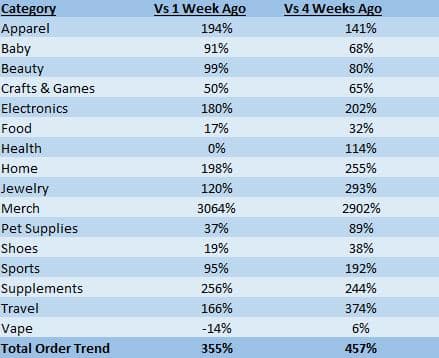
Today is Cyber Monday and the holiday rush is in full swing, as shown by the huge increases in volume over prior weeks. The ShipHero team is on it, helping our customers meet the surging demand.More charts available on data.shiphero.com.Do you find this information useful? Let us know! Twitter: @weareshiphero or Email al@shiphero.com.
ShipHero Ecommerce Fulfillment is in high gear as we surpassed our all-time record volume.
Yesterday was our best sales day ever and today will be our second-best ever.
Here are the statistics for Black Friday and today, Saturday November 28:
Black Friday (as defined by UTC, so starting at 7PM Eastern Thursday) ShipHero orders were up 79% year-over-year.
On Saturday (as defined by UTC, so starting at 7PM Eastern Friday) orders were up 117% year-over-year (more than doubling versus last year).
In addition, on Black Friday, the calendar day, as defined by Eastern Time, ShipHero processed 648,847 orders, up 87% year-over-year. Shopify reported being up 58% YoY for that same period.
As always, ShipHero is here to meet the holiday demand with fast and accurate ecommerce fulfillment. See what we can do for you here.



.svg)