October 21, 2026
Two cloud WMS platforms for 3PLs, compared on picking and packing, wholesale fulfillment, labor costs, and client billing.
Packiyo

ShipHero and Packiyo are cloud WMS platforms for 3PLs, and both run multi-client inventory, mobile picking with location-based routes, client billing, and branded client portals. ShipHero is built around picking and packing workflows, labor cost by client, and billing for each service performed, with optional light-directed hardware. Packiyo publishes pricing for selected plans, with Starter and Enterprise quoted.
Consider
Packiyo
when you want

Leader in G2's Fall 2026 Grid® Report for 3PL. See the category on G2
| Capability | ShipHero | Packiyo |
|---|---|---|
| Picking and packing | ||
| Receiving, putaway, lot and serial tracking | Barcode receiving, putaway, and replenishment on the native mobile app. Lot, expiration, and serial tracking, with serial capture during packing | Receiving against purchase orders, lot, batch, and serial tracking, expiration management, and bin-level locations |
| Batching and pick sequencing | Multi-item batch, single-item batch, and wave picking, with pick priority per location. Location-Aware Picking offers proximity batching and mapped routes. Wave Picking requires Location-Aware Picking and Pick-to-Light hardware. Route optimization requires a mapped warehouse. | Single-order, single-item, and batch picking, with location-based pick routes and barcode validation on iOS and Android |
| Light-directed and pack-station hardware | Pick-to-Light, Pack-to-Light, Receive-to-Light, and Tap-to-Pack, supplied by ShipHero and native to the WMS | No native light-directed hardware. Packiyo recommends standard scanners, printers, and mobile devices |
| DTC and wholesale fulfillment | ||
| Wholesale workflow | Picking plan, pick, pack, label, and outbound schedule, for pallets or boxes. Courier labels quoted in ShipHero | Split shipments, partial fulfillments, and backorders on its features page. Copilot rules can filter wholesale orders |
| Retail compliance labels | Native GS1 and UCC-128 label library for 400+ retailers. Setup fee and monthly fee per retailer connection | Not compared |
| EDI connectivity | EDI-agnostic. Connects through SPS Commerce for purchase orders, ship notices, and inventory updates | EDI and wholesale connections are listed in its integration setup |
| Client billing and labor visibility | ||
| Labor cost visibility | Labor Cost Dashboard: cost per shipment, line item, or unit, by client and warehouse, with CSV export | Productivity tracking and client-level reporting. Logged work can be billed as ad hoc charges |
| Client billing and carrier reconciliation | Billing profiles by client and warehouse for receiving, storage, picking, shipping, returns and ad hoc work. WorkforceHero hours can feed work-order charges for future invoices. Carrier Reconciliation compares quoted shipping costs with uploaded carrier invoices | Rate cards for shipping, picking, storage, packaging, and ad hoc work, including hourly charges and label-cost markups |
| Client portal | Client self-service for creating, bulk uploading and merging orders; managing inbound shipping plans and returns; and viewing inventory and reports. Warehouse access is configured by the 3PL. Includes company branding, with a custom login subdomain available on request | Client access to inventory, order creation and editing, inbound purchase orders, products, returns and reports, subject to permissions and order status |
| Multi-warehouse inventory and routing | Configurable order-routing and split-order rules across warehouses for DTC orders. Wholesale orders ship complete from a single warehouse and staging location | Multi-warehouse routing in its 3PL package. Copilot can assign a warehouse by ZIP code, zone, or first available |
| 4PL and cross-3PL networks | Share a client across multiple ShipHero 3PLs and allocate orders between them. Requires consent from both 3PLs and the client, plus ShipHero Support setup | Multi-warehouse routing supported. Shared-client fulfillment across independent 3PL accounts is not documented in public product materials |
| Data access and integrations | ||
| Integrations and API | Shopify, Amazon, Walmart, TikTok Shop, BigCommerce, NetSuite, and more. GraphQL API | Shopify, Walmart Marketplace, TikTok Shop, WooCommerce, USPS, UPS, FedEx, and more, per its own pages, plus an open API |
| Scheduled data exports | Included: weekly full and 6-hour delta exports. Paid: daily full and 30-minute delta | Not compared. Packiyo offers an open API |
| AI access | Connect Claude, ChatGPT or Codex to live ShipHero data through the official MCP. Ask operational questions in plain language. With API access enabled and optional write access, create orders, adjust inventory, process returns, resolve holds and add 3PL charges through supported API operations. Read-only access is also available | Copilot, a rules engine for order automation. No official MCP server |
| Implementation and commercial | ||
| Implementation and G2 reviews | Typical onboarding planning ranges: 6 to 8 weeks for Standard and 8 to 12 weeks for Advanced. Timing depends on operational complexity, integrations, warehouse readiness and team availability. G2 overall: 4.5 from 232 reviews. Reviewer-reported: 2 months to implement, 8 months to ROI | Packiyo states a 14-day standard onboarding SLA; timing varies with operational complexity, integrations, and customer availability. G2: 1 review, which G2 says is not enough for buying insight |
| G2 Grid® for 3PL (Fall 2026) | Leader. Highest G2 Score of the 17 products in the report | Not in this Grid |
| Pricing and ownership | Quote-based. Location-Aware Picking and GS1 labels priced separately | Packiyo publishes pricing for selected plans; Starter and Enterprise require a tailored quote. The 3PL package includes 5 users and up to 5,000 shipments a month |
Sources for every cell are listed at the end of the page.
ShipHero supports multi-item batch, single-item batch, and wave picking, with pick priority set on each location. Location-Aware Picking, an add-on with usage-based pricing, uses your warehouse layout to group orders into batches and shows each picker a highlighted route. Pickers walk up to 30% less. Wave Picking requires both Location-Aware Picking and Pick-to-Light hardware, and route optimization depends on a mapped warehouse.
For higher volume, ShipHero sells light-directed hardware that connects straight to the WMS. Pick-to-Light guides pickers to the right tote and quantity, Pack-to-Light and Receive-to-Light run on the same system at packing and receiving, and Tap-to-Pack replaces the keyboard and mouse at the pack station. ShipHero reports 20% higher picking efficiency with Pick-to-Light and 8 seconds saved per order with Tap-to-Pack.
Packiyo's iOS and Android apps run single-order, single-item, and batch picking, with barcode validation and a picking route once product locations are set. Packiyo has no native light-directed hardware.
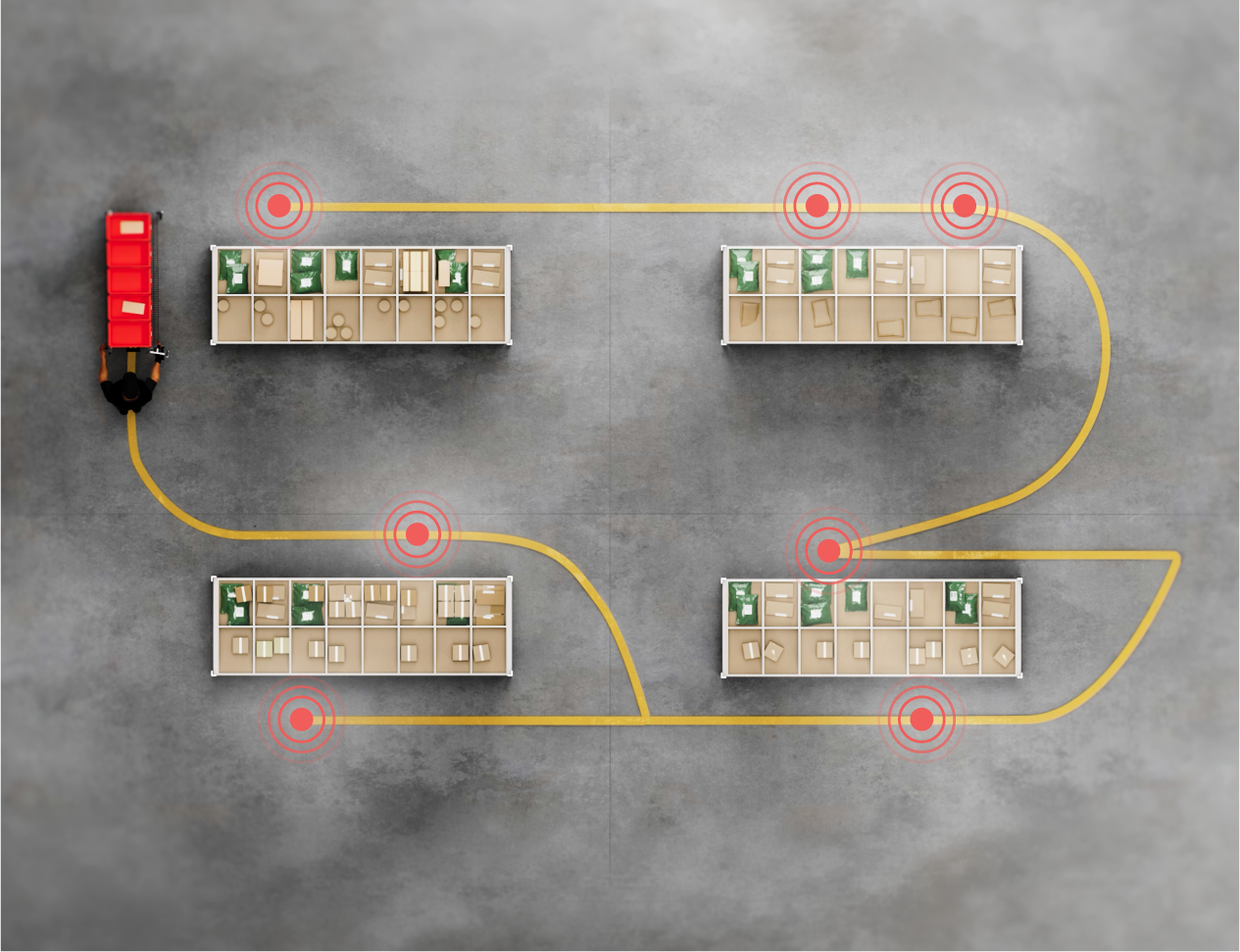
A mapped picking route guides workers between locations across the warehouse floor.
25%
Frost Buddy: 25% lower labor costs with Location-Aware Picking
Frost Buddy, a drinkware brand that runs its own warehouse, reports that Location-Aware Picking cut its labor costs by 25%, and that Direct Pack-to-Light stations save $80,000 a year in labor. It scaled from 4,000 to 20,000 units a day during peak season.
ShipHero video case study, April 28, 2026. One customer's reported result.

See each pallet’s LPN and contents in the wholesale packing layout.
In ShipHero, orders flagged as wholesale follow one path: picking plan, pick, pack, label, and outbound schedule. They ship as pallets or boxes, and each order gets its own staging location. A native GS1 label library covers 100+ retailers, and ShipHero's team sets up each retailer connection, with a setup fee and a monthly fee per retailer.
ShipHero is EDI-agnostic and connects to the EDI provider you choose. Through SPS Commerce, retailer purchase orders flow into ShipHero, ship notices and inventory updates flow back, and ShipHero Support sets up and tests your trading partners before go-live. The wholesale flow supports Build Kits only, ships each wholesale order complete from a single warehouse and staging location, and does not quote or generate freight labels. DTC orders can still use split-order rules across warehouses.
Packiyo lists EDI and wholesale connections in its integration setup, and its features page lists split shipments, partial fulfillments, and backorder management.
$20K
Brandfox: $20,000 in monthly labor savings from removing manual wholesale tracking
Brandfox is a U.S. fulfillment provider handling eCommerce, B2B, and retail orders for clients such as Target and Sephora. It tracked wholesale cases in Google Sheets until ShipHero's wholesale workflow replaced that manual tracking.
ShipHero case study, November 15, 2024. Previous systems: AS/400 and ShipStation. One customer's reported result.
Two clients can ship similar volumes and require different amounts of warehouse work. ShipHero’s Labor Cost Dashboard shows labor cost per shipment, line item or unit, broken down by client and warehouse. Compare picking, packing and inventory-movement costs to identify workflows and service pricing worth reviewing. Calculations use tracked activity and the labor information you enter. Not every warehouse task is automatically timed, and this is labor-cost analysis, not a full client profitability calculation.
Use 3PL Billing profiles to configure charges for each client and warehouse, including receiving, storage, shipments, picking, returns and ad hoc work. For special projects, WorkforceHero can send tracked hours to a work order’s ad hoc charges. When the work order is marked Done, those charges flow to the next generated invoice. Carrier Reconciliation compares quoted shipping costs with an uploaded carrier invoice. Matched differences are added to the client’s next bill. Only configured fees are charged.
Packiyo offers productivity tracking and client-level reporting. Its rate cards cover shipping, picking, storage, packaging, and ad hoc work, including hourly charges and label-cost markups.

Compare labor cost and time per shipment across clients.
100K+
Tidalwave: 100,000+ monthly orders, with clients managing their own order changes
Tidalwave Print & Fulfillment is a Chattanooga 3PL. ShipHero's client portal lets its brand clients edit orders and place holds without contacting the warehouse, and onboarding a new client now takes one to two days instead of weeks. One packer at a ShipHero station processes more than 1,000 orders a day.
“I believe ShipHero gives us all the tools for success to run a 3PL.” Matt Schroeder, Co-Founder
ShipHero case study, September 9, 2025 (video). Previous system: ShipStation. One customer's reported result.
Every ShipHero account includes scheduled data exports for Business Intelligence (BI) and data warehouse tools, plus webhooks and a GraphQL API for event-driven needs. The exports are scheduled files, not real-time feeds. The ShipHero AI Toolkit includes an MCP server, so you can connect Claude, ChatGPT, Codex, or another MCP-compatible assistant to ShipHero data. Ask what shipped yesterday. You choose read-only or read-write access when you connect, and with write access enabled, the assistant can perform supported Public API actions.
Packiyo offers an open API and Copilot, a rules engine for order automation. It has no official MCP server.
A demo walks through picking, wholesale, and client billing with your order mix.
Where
Packiyo
may be the better fit
Switching from
Packiyo
to ShipHero
ShipHero's standard onboarding runs 6 to 8 weeks, and advanced implementations run 8 to 12 weeks.
01
Map receiving, putaway, picking, packing, and shipping, and collect carrier and store data.
02
ShipHero's team helps you plan the move of products, locations, inventory, and client accounts.
03
Label locations and run a physical inventory count.
04
Validate carriers, rates, workflows, and integrations, train staff, and set the go-live date.
Retailer programs. ShipHero's team sets up each GS1 label connection and each EDI connection, and testing follows.
Location names. Location-Aware Picking works best with consistent, logical location names.
Billing profiles. Configure fees and assign a profile to each client and warehouse before the first bill.
Labor rates. The Labor Cost Dashboard multiplies tracked time by your labor rates, so have them ready.
ShipHero is the stronger fit for 3PLs and brands looking for DTC and wholesale fulfillment in one WMS, with workflows suited to each order type. Its offering includes light-directed hardware, labor cost reporting by client and configurable client billing. Packiyo fits operations where published entry pricing or its stated onboarding SLA drives the decision. On G2, ShipHero rates 4.5 from 232 reviews (page data as of October 17, 2026), and Packiyo has one review.
Packiyo publishes pricing for selected plans; Starter and Enterprise require a tailored quote. Its 3PL package includes 5 users and up to 5,000 shipments a month. Packiyo includes standard onboarding and charges extra for onsite implementation. See Packiyo's pricing page for current rates.
We price ShipHero by quote, based on your order volume and the modules you need. Location-Aware Picking and GS1 retailer labels are priced separately.
Typical planning ranges are 6 to 8 weeks for Standard onboarding and 8 to 12 weeks for Advanced onboarding. Your timeline depends on operational complexity, integrations, warehouse readiness and team availability.
Yes. Packiyo's rate cards cover shipping, picking, storage, packaging, and ad hoc work, including hourly charges for logged work.
ShipHero sells one WMS to 3PLs and brands, so brands get the same picking, packing, shipping, and receiving tools that 3PLs do. Packiyo also offers packages for brands. Compare either against your own order mix.
ShipHero connects natively to Shopify, Amazon, Walmart, TikTok Shop, eBay, BigCommerce, and NetSuite, plus UPS, FedEx, USPS, and DHL. See ShipHero's full integrations list.
Yes. ShipHero is EDI-agnostic and connects through SPS Commerce or other EDI providers. It also generates GS1 retailer compliance labels for 100+ retailers.
Not natively. Packiyo doesn't offer its own light-directed hardware. ShipHero sells Pick-to-Light, Pack-to-Light, Receive-to-Light, and Tap-to-Pack as first-party hardware built for its WMS.
No. Packiyo has no official MCP server. It offers Copilot, a rules engine for order automation. ShipHero offers an official MCP server that works with Claude, ChatGPT, Codex, and other MCP clients.
Checked October 19, 20, and 21, 2026 unless noted.