
.svg)

In this article, we’ll discuss Multimodal and Intermodal Shipping. What is multimodal and intermodal shipping? What are the pros/cons of each? How do they compare/contrast and which one right for my business, if any? Let’s dive in.
.svg)
Welcome to our Shipping Methods Explained blog series. In this series, we will deep dive into fulfillment methods - that is, how businesses fulfill their online orders and get products to their customers.
Sounds simple right? Well, in theory it is. You could hop on your itty-witty bicycle and hand-deliver your product, mission accomplished. But consider the complexity when your company fulfills hundreds to thousands of orders daily, not to mention the skyrocketing shipping costs that could price you out of the market.
Managing inventory, navigating each carriers’ specific requirements, calculating the lowest cost from thousands of shipping options… it’s a daunting task. That’s why more and more businesses are outsourcing their fulfillment methods.
Are you ready to outsource your fulfillment? Let’s analyze your options to help you decide the best method for your business. In this article, we’ll discuss Multimodal and Intermodal Shipping. What is multimodal and intermodal shipping? What are the pros/cons of each? How do they compare/contrast and which one right for my business, if any? Let’s dive in.
(Check out our previous articles on Dropshipping, FaaS, and FBA/FBM. And be sure to check back for future articles where we’ll cover even more fulfillment methods)
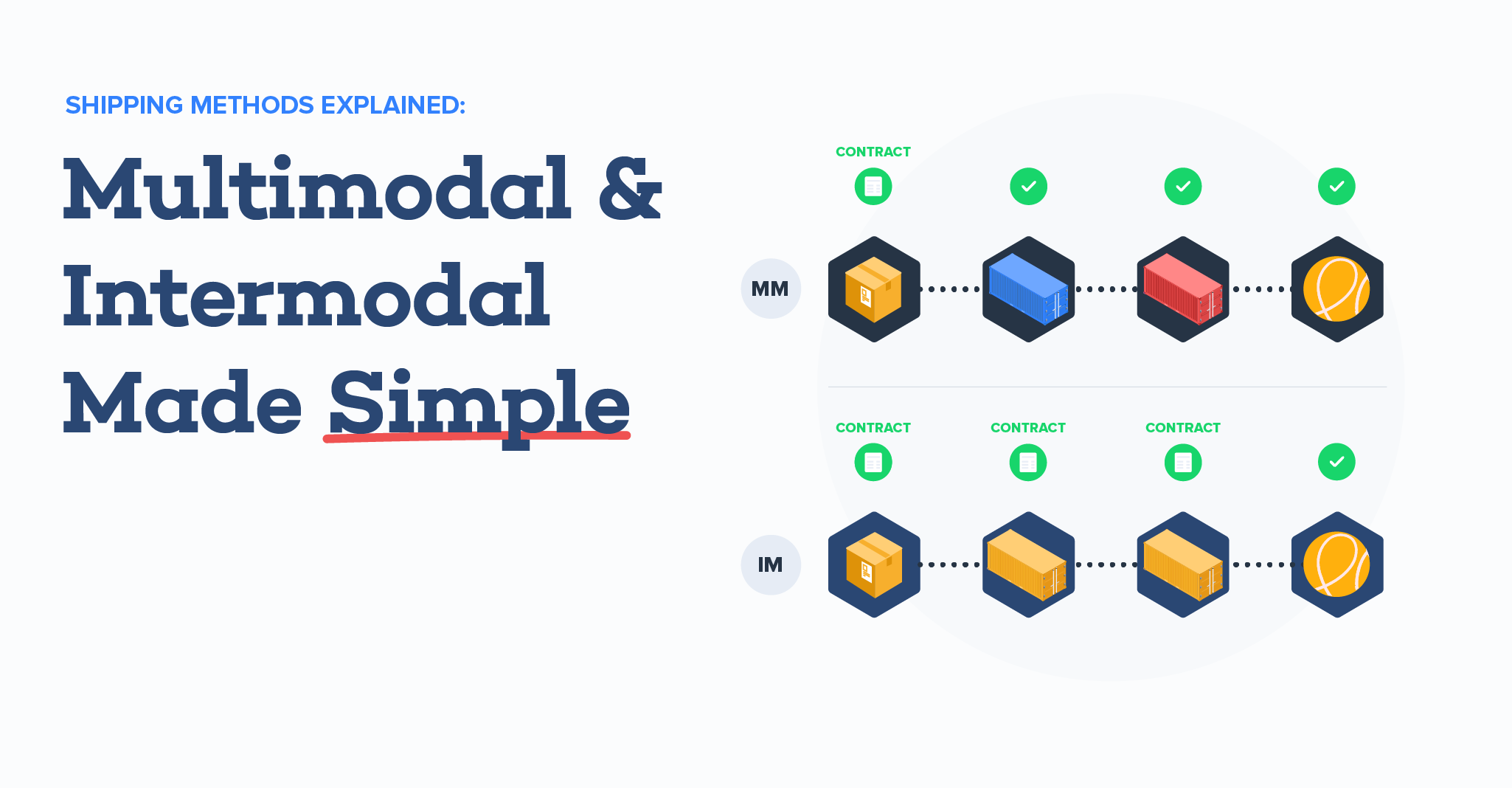
Multimodal transport is also known as ‘combined transport’ because the products are moved using different modes of transportation along the fulfillment journey, but under the terms of a single contract and facilitated by a multimodal transport operator (MTO). Whether by road, sea, air or rail, or a combination of them all, the MTO is liable for the entire journey from beginning to end, although they often use sub-contracted carriers that specialize in each mode of transportation.
Intermodal transport involves the use of an intermodal container which carries products throughout the entire fulfilment journey; regardless of the type of transportation, the same intermodal container will be offloaded from one method and loaded onto the next without ever moving the product inside.
The main difference between multimodal and intermodal transport is: 1) how the product is transferred between transportation modes, and 2) how the contracts are made with each carrier.
With multimodal transport, the products or commodities are loaded and unloaded into transportation-specific containers when transferring, say, between sea and rail, rail and ground, etc. Excessive product transfer may result in product damage or loss; you may have heard the phrase “fallen out of a truck” when asking your relative about an expensive purse they clearly can’t afford. In fact, product damage during transportation costs up to $0.48 per pallet annually, which certainly adds up over time with larger supply chains.
This is the benefit of intermodal transport, because the products are loaded into a single intermodal container to be used for several modes of transportation. The products themselves will remain secure as the container itself is loaded and offloaded from a truck, train, ship or air freight.
Using one intermodal container allows for safer packing of products, which results in less damage and loss, as well as quicker and more efficient movement between freight methods. For this reason, intermodal transport tends to be less costly than multimodal transport.
During a multimodal transport, the shipper creates a single contract with the Multimodal Transport Operator (MTO), which is wholly responsible for the cargo from the origin to the end destination. This allows the shipper to simplify the communication process by just working with a sole transport provider or agent. Also, the simplified communication allows for more accurate shipping updates, tracking notifications, and opportunities for optimization. On the other hand, the shipper must rely on the MTO to select the best/cheapest routes for their cargo, and flexibility is limited.
Conversely, during an intermodal transport, the shipper must create multiple contracts with individual carriers. While there is only one intermodal container, it will be passed between many liable parties, increasing the complexity for the shipper in terms of communication and optimization across carriers; however, the shipper has more flexibility to independently choose each leg of the fulfillment journey.
In summary:
Multimodal Transport
Intermodal Transport
In conclusion, shippers must determine if multimodal or intermodal is the right choice given their circumstances, i.e., is your product fragile or at risk of damage/loss, do you have the resources to schedule and manage carrier contracts, etc. Thankfully, smart fulfillment providers and 3PLs like ShipHero can help you determine the best way to ship.
Be sure to stay tuned to our Shipping Methods Explained series as we deep dive into the specifics of fulfillment.
Learn more about ShipHero’s industry-leading warehouse management software.
.webp)
Explore the top 3PL companies in Canada and learn how third-party logistics providers play a vital role in optimizing supply chains. Discover the benefits of partnering with a 3PL, key services offered, and steps to start working with a 3PL in Canada.
.svg)
Discover the top 5 best third-party logistics (3PL) companies for your business needs, offering extensive networks, advanced technology, and superior customer service. Learn about the benefits of 3PL services, how to choose the right provider, and avoid common mistakes.
Discover the role, benefits, key features, requirements, and implementation of a 3PL Warehouse Management System (WMS) for optimizing warehouse operations. Learn about scalability, integration, real-time visibility, and customization options to choose the best solution for your business.

On September 1, 2026, Descartes Systems Group announced its acquisition of Extensiv for approximately $120 million. What was announced, what usually follows deals like this, and the questions Extensiv customers should put to their vendor before renewal.



.svg)



.webp)