
.svg)

Let’s stay in touch with the ShipHero Blog.


.webp)
The ShipHero Model Context Protocol (MCP) connects supported AI clients directly to your live ShipHero data, so warehouse teams can ask questions and get specific answers from their own account. It is built for day-to-day operational checks, including inventory levels, open orders, shipment status, holds, returns, purchase orders, and exceptions. For ShipHero customers, it is available at no additional charge and runs on existing API credits.
Every order, shipment, inventory movement, hold, return, and purchase order creates data inside ShipHero. Your warehouse information is right there, but getting to it can be a slow, complex process.
Before the ShipHero MCP, answering a specific operational question often meant logging in, finding the right report, applying the right filters, exporting data, or asking the one person on the team who knew where to look.
Even when the answer was simple, like a quick inventory check, it could turn into a 20 to 45 minute task. A customer question could sit half a day while someone pulled the right numbers. That delay adds friction to the floor. It slows decisions. It keeps teams waiting on data they already own.
The ShipHero MCP gives supported AI clients secure, read-only access to live ShipHero data.
That means operators can ask questions in plain English and get answers from their actual account, not from a generic help article or static knowledge base. A chatbot can tell you where to find a number. The ShipHero MCP can return the number itself.
It works with MCP-enabled AI clients, including Claude, ChatGPT, Cursor, and Codex. Connect it once, authenticate access, and your team can start asking operational questions from the AI tool they already use.
The workflow is simple:
The MCP does not replace ShipHero. It makes the data inside ShipHero easier to reach when your team needs a fast answer.
The ShipHero MCP is designed for everyday operational questions, such as:
If the data lives in your ShipHero account, the MCP gives your team a faster way to ask for it.
Speed matters, but safety matters too.
The ShipHero MCP is read-only by design. It can retrieve information from your account, but it cannot create orders, modify records, delete data, or change warehouse settings.
That gives teams a practical way to use AI for operational visibility without risking accidental account changes. Operators can ask. Managers can check. 3PL teams can answer client questions faster.
The data becomes easier to use, while the records stay protected.
For founders, the MCP can turn a quick inventory check into a simple question.
For operations leads, it can surface shipment status, holds, exceptions, and low-stock SKUs without digging through reports.
For 3PL operators, it can help answer client questions faster, using live account data instead of manual follow-up.
The result is a faster way to reach the information already inside ShipHero.
The ShipHero MCP is available to all ShipHero customers at no additional charge. It runs on existing API credits, so specific questions help keep usage efficient.
To get started, visit developer.shiphero.com or contact your ShipHero account representative.
ShipHero MCP is a read-only connection between supported AI clients and your live ShipHero data. It lets users ask operational questions in plain English and receive answers from their actual ShipHero account.
A chatbot usually answers from fixed, generic information. ShipHero MCP connects to live account data, so it can return specific answers about your orders, shipments, inventory, holds, returns, and other ShipHero records.
ShipHero MCP works with AI clients that support the Model Context Protocol, including Claude, ChatGPT, Cursor, and Codex.
No. ShipHero MCP is read-only. It can query data, but it cannot create, update, or delete records in your ShipHero account.
No. The MCP is built for operators and can be connected from a supported AI client in minutes. Developers may use more advanced tools for deeper analysis, but most day-to-day users can work directly with the MCP.
Yes. ShipHero MCP is available to ShipHero customers at no additional charge and runs on existing API credits.
Transitioning to a new Warehouse Management System (WMS) is a high-stakes decision that often triggers concerns regarding downtime, data integrity, and workforce adaptation. As warehouses prepare for 2026 growth, understanding these common hurdles—and the technical solutions that resolve them—is essential for a successful migration. This guide addresses the five primary barriers to adoption and how a high-velocity infrastructure ensures a seamless transition.
Warehouse operators frequently hesitate to upgrade due to perceived risks that can halt operations. These challenges typically include:
To clear these hurdles, a structured implementation strategy is used to prioritize data density and entity clarity.
In the competitive eCommerce landscape, staying stagnant with manual workarounds is often more costly than the transition itself. Moving to a high-velocity WMS converts your warehouse from a cost center into a growth engine by providing Labor Efficiency and ROI through automated routing and reduced authentication friction.
Because the platform is built for the floor worker, features like Workforce Hero allow seasonal temps and new staff to be authenticated and productive in under an hour.
No. High-velocity infrastructure increases visibility by providing Total Real-Time Control. Managers can monitor exactly what is in the Hospital queue and track replenishment in real-time from a single dashboard.
Before going live, a ground-up audit is performed using cycle counting tools. The system's architecture ensures that every movement on the floor is synchronized with sales channels instantly, maintaining 99.9% accuracy.
Picture a packer at Peak Season. A box is in front of them, a product in each hand, and somewhere on a cluttered desk there's a mouse they need to find to confirm the order. They look down. They hunt. They click. Then they do it again. Thousands of times a day.
That moment of friction is small. But it is never just one moment. Multiply it across your entire pack line, across an entire shift, and you are looking at a measurable and largely invisible drag on your total throughput.
Tap-to-Pack is a purpose-built hardware controller designed by ShipHero to eliminate digital friction at the packing station. It connects via USB-C, requires no drivers or additional software, and syncs automatically with the ShipHero WMS packing app. This new system is now available at the ShipHero Store.
Instead of navigating a screen with a keyboard and mouse, packers execute every high-frequency command — such as selecting box sizes, printing labels, finalizing orders, flagging exceptions — with a single physical tap on one of eight programmable buttons.
Key specifications:
Most warehouses are running 2026 operations on 1990s peripheral standards. The keyboard and mouse were designed for spreadsheets and emails, not high-volume fulfillment. When used at a packing station, they create three compounding problems:
The problem is not your people. It is the tools you are asking them to use.
Tap-to-Pack introduces a "Rodent-Free" packing standard: a workflow where the packer's hands stay on the product, their eyes stay on the work, and the software fades into the background.
The device guides the packer through two feedback systems:
ShipHero customers running Tap-to-Pack are already seeing a 90% reduction in on-screen interactions and a significant increase in the number of orders packed per hour, without adding headcount or changing their warehouse layout.
One of the hardest challenges in fulfillment is absorbing volume quickly, especially during Peak Season, when temporary staff need to reach target productivity fast.
Because Tap-to-Pack's interface is physical and intuitive, there is almost nothing to teach. Pick up the product, follow the light, tap the button. New packers can reach target productivity in minutes rather than hours.
The system is also modular:
Whether you are a growing DTC brand or a high-volume 3PL, Tap-to-Pack is designed so your hardware never becomes a ceiling on what your team can do.
Tap-to-Pack is a programmable, industrial-grade hardware controller that connects to the ShipHero WMS and allows warehouse packers to execute packing station commands, such as printing labels, selecting boxes, and completing orders. All with a single physical button press, eliminating the need for a keyboard and mouse.
The device connects via USB-C and syncs automatically with the ShipHero WMS packing app. It is a true plug-and-play solution: no drivers, no background software, and no manual configuration required.
Yes. Buttons are configurable for a range of packing actions, including Print Label, Complete Order, Select Box Size, and the Hospital function, which flags a problematic order and keeps the line moving without stopping to resolve it on screen.
The system is fully modular. Connect up to two additional 8-button hubs to the Main Hub for a total of 24 programmable buttons, supporting even the most complex multi-step packing workflows.
Tap-to-Pack devices require ShipHero Packing App v1.0 or higher. The current release is v1.1.0.
Imagine running a warehouse where orders are picked quickly, inventory is accurate, and all operations run smoothly without any errors or delays. Thanks to Artificial Intelligence, this can now become a reality with ease.
AI is transforming warehouse management by enhancing efficiency, intelligence, and the ability to meet the rapid demands of today’s eCommerce-driven market.
ShipHero is pioneering this revolution with its AI-powered warehouse solutions, setting new industry benchmarks. This article explores ShipHero’s AI Picking feature, highlighting how it’s transforming warehouse management and enhancing operational efficiency.
The integration of AI technologies, including machine learning, robotics, and predictive analytics, is revolutionizing warehouse operations, driving significant improvements in efficiency, accuracy, and overall performance. These innovations are optimizing processes across various areas, from inventory management to order fulfillment. Below are the key benefits of AI in warehouse management.
A combination of AI technologies is shaping smarter warehouse systems to help revolutionize warehouse management.
ShipHero has taken AI integration to the next level with its AI Picking feature, designed to significantly improve warehouse efficiency. This feature automates the picking process, reducing the reliance on manual labor and enhancing productivity in ways that were once thought impossible.
Let’s dive deeper into how ShipHero’s AI Picking works and the advantages it offers.
AI Picking optimizes warehouse operations in two key ways:
The AI Picking feature delivers a wide range of benefits:
The transformative power of AI extends far beyond just picking. AI is also revolutionizing other aspects of warehouse management, driving improvements in operational efficiency, inventory management, and safety.
AI automates tasks, reducing errors and increasing speed. Automated sorting and real-time inventory tracking ensure accuracy, while real-time monitoring helps managers adapt and ensure timely deliveries.
AI plays a vital role in maintaining accurate inventory levels. By leveraging predictive analytics, AI can forecast demand and optimize stock levels, helping warehouses avoid both stockouts and overstock situations. This leads to better inventory management and fewer disruptions in supply chains.
AI-driven systems can monitor warehouse conditions to ensure safety and compliance with industry regulations. These systems can analyze warehouse data and predict potential hazards before they occur, proactively reducing risks and ensuring a safer working environment.
AI technologies are playing a transformative role in the supply chain and logistics sectors by improving efficiency, reducing costs, and enhancing decision-making.
These intelligent systems effortlessly manage supply chain processes by using data to optimize operations, predict trends, and automate routine tasks. This ultimately reshapes everything, from how goods are moved to stored and delivered.
The future of warehouse management looks promising with greater automation and efficiency, but future warehouse digitization brings challenges, such as high upfront costs and the need for skilled personnel.
AI-powered drones, autonomous robots, and IoT integration are smart warehouse technologies that are revolutionizing warehouse operations. Drones will deliver goods quickly, while robots automate sorting and transportation, thereby reducing the need for manual labor.
IoT and AI integration will enable real-time monitoring and optimization of operations. Smart technology in warehouses is leading to fully automated systems that are faster, scalable, and need minimal human input.
While AI offers immense benefits, businesses must also consider certain challenges. High initial investments in AI technology, data security concerns, and the need for skilled personnel are just a few of the hurdles that must be addressed.
However, with a strategic approach, companies can eliminate the challenges and embrace AI’s full potential to boost accuracy in picking and improve overall warehouse operations.
AI minimizes error by automating tasks like inventory tracking, order picking, and sorting, ensuring greater accuracy and efficiency.
Yes, AI-driven predictive analytics can predict demand, track inventory levels, and improve supply chain efficiency by forecasting needs with greater accuracy to help businesses stay ahead of trends and market fluctuations.
AI solutions are becoming more cost-effective thanks to cloud-based services and subscription pricing models. These options make AI technology more accessible to small businesses, allowing them to take advantage of its benefits without large upfront costs.




Proper inventory management is crucial to building a thriving Shopify store. Statistics from Shopify reveal that sellers accrue almost $2 trillion in costs due to inventory mismanagement. The losses are spread among overstocking, out-of-stock items and preventable returns.
Interestingly, these aren’t the only problems associated with inventory management. Shopify store owners still have to battle missing items, misplaced inventory, wrong product packaging and delivery, among others. If you can establish a solid foundation for tracking inventory on your Shopify store, you’re on your way to building a genuinely agile eCommerce business.
Inventory management refers to how businesses manage goods as they move along the supply chain. eCommerce inventory control ensures that companies know their products are in stock and are notified when inventory needs to be replenished.
Ultimately, a good inventory management system should minimize costs, satisfy customer demand and help you maintain optimal inventory levels. It should also centralize your data, making it accessible to the appropriate point persons.
Part of stock management is inventory control, which is the process of handling existing inventory, while the former primarily involves forecasting, ordering and receiving goods.
Inventory management is the key to any eCommerce business’ success. It ensures customer satisfaction, keeps businesses profitable and minimizes operational costs. Other benefits of having an effective inventory management system include the following.
When your inventory moves faster and your product lines stay healthy, you don’t put anything to waste. Regular inventory updates can help you avoid spoilage with perishable goods like food and beverages. Similarly, automatic stock updates can prevent dead stock, which are non-perishable products that are no longer in season.
Most American retailers without powerful inventory software only have an inventory accuracy level of 65%. The more warehouse locations they have, the more this percentage falls.
Fortunately, perpetual inventory systems inform you of available inventory items in real time, preventing stockouts and missed sale opportunities. Instead of scrambling to increase your stock flow, early stock alerts can remind you to make refills in advance.
Cash flow shortfall is a persisting problem for businesses without perpetual inventory systems. The best way to increase cash flow is to turn inventory into revenue. When you factor inventory into your business operations, you get insight into how much you can sell and buy at any given time.
Remember, inventory flow can directly impact your future sales. Projecting when you’re about to run out enables business owners to accurately plan and increase sales.
Efficient inventory counts tell you what items are selling fast and which don’t. You can free warehouse space up and store items that sell more by keeping up with sales volumes.
In addition, you can monitor every single product that doesn’t sell, potentially cutting them out of your inventory. When you stock only what is necessary, you can downsize your warehouse and save on costs.
By employing effective inventory management methods, you can hasten the fulfillment process. For instance, if you have multiple fulfillment partners, inventory management techniques like distribution ensure that you are close to buyers and can keep customers happy. Doing so also ensures that customer returns are seamless and you can easily re-enter usable inventory into circulation.
Inventory management systems enable users to track inventory quantity and streamline processes from purchasing to end sales. Key features of a stock management system include:
Inventory management for Shopify stores is the systematic approach to sourcing, storing and tracking your inventory. With a proper inventory management system in place, you’ll have the right stock at the right levels, in the right place, at the right time and at the right price.
Plus, it’ll reflect on your Shopify store listings. That way, you can avoid preventable losses due to out-of-stock items, overstocking and returns, and your brand has a better shot at survival, growth and profitability.
Inventory management is crucial to the success of Shopify stores. If you can get this aspect of business right, you’ll reduce overall inventory costs, optimize order fulfillment and position yourself to serve your shoppers better. Below are some of the benefits of proper inventory management:
Shopify store owners understand that meeting customers’ needs is crucial to profitability. If you frequently run into stock management problems like overstocking, out of stock or overselling, you’re likely to have many dissatisfied customers. Ultimately, they would go elsewhere to make a purchase, and you may never see them again.
If you have too much stock that you can sell within a reasonable period, you’re leaving your capital idle while wasting precious storage space. Knowing how much product to stock helps minimize the amount of dead stock on your shelves and levels out cash flow.
Proper inventory management facilitates seamless selling across multiple marketplaces. For example, suppose you’re selling on Shopify, Amazon, eBay, Etsy and your business website. In that case, you’ll need to stay on top of your stock levels to convey accurate information to customers across these platforms. Inventory management also helps you accurately forecast demand, so you’ll always have what your customers need in stock.
Virtually every task involved in inventory management helps you manage your resources efficiently. If you stock the right amount of the right products, you won’t waste inventory dollars on storage space. There’ll also be fewer cases of spoiled or expired inventory since your turnover rate will be optimal. Furthermore, the potential gains of having what your customers need in stock whenever they need it is unquantifiable.
Due to varying demand levels, you may frequently have to transfer inventory from one marketplace to another when selling across multiple channels. If you do not follow the right inventory management practices during the transfers, tracking each channel’s inventory levels gets harder.
Shopify has built-in inventory management software that’s adequate for tracking your inventory and managing sales on Shopify. However, the native Shopify app can’t cater to retailers’ unique needs who sell on multiple channels. Here are three common problems you’re likely to experience with Shopify’s native inventory management solutions:
Shopify has a long list of restricted and prohibited items. If you sell one of these products on other platforms, you’ll be facing a significant challenge with multi-channel inventory management.
Often, the only viable option is to have separate inventories for Shopify and other platforms. This complicates the inventory tracking process and can lead to inaccurate or inconsistent stock levels across the different channels.
As your SKU library expands, your inventory management process will likely become more complicated, and there’ll be more opportunities for inventory management errors. To prevent these problems, you need inventory management software that automatically replenishes depleted stock from suppliers.
Such a program should recommend order quantities by factoring in your sales volume on Shopify and other channels. Unfortunately, the native Shopify app may be unable to carry out the task effectively.
The native Shopify inventory management software does not fully support multi-channel selling. For example, the app cannot estimate all the product variants in your online stores. This information is vital to evaluating the performance of your products on channels other than Shopify.
When your system reports items that don’t exist in your store, you risk creating phantom inventory. Without accurate and powerful reports, your business can become susceptible to errors and shrinkage.
While enterprise resource planning has its advantages, it does come with a steep learning curve, so always brush up on your inventory management tips.
How you utilize the different types of inventory management will ultimately depend on your business goals, existing systems, retail locations and other requirements. You can implement several strategies when using inventory management for the Shopify app.
The first-in, first-out (FIFO) principle prioritizes selling the old stock first, which is an ideal method for retailers that sell perishable goods. To achieve a FIFO system, warehouse management begins from the back, pushing older products to the front.
Opposite the FIFO method is last-in, first-out or LIFO. This method involves selling your newest stock first, which benefits businesses that want to curb rising prices. While this method will lower taxable income, it will also yield lower profits and can negatively impact your retail business’ bottom line.
Facilitating a regular inventory and supplier audit can put the current state of your business into context and pinpoint areas of improvement. There are several ways to keep track of low or excess inventory:
On top of physical audits, supplier audits can help identify areas of risk, improve your standards, enhance supplier communication and increase customer satisfaction.
Relationship management is imperative to adapting quickly, especially if you have more than one retail store location or a thriving online business.
If you have a bad supplier, you could have insufficient inventory or too much of it. The better your relationships, the easier it’ll be to bring up issues with suppliers and resolve them. Keep your suppliers in the loop by letting them know when you’re expecting a sales increase, if you’re experiencing inventory dips or if a specific product is running behind schedule.
Accurate forecasts are challenging to achieve but not impossible. If you want to ensure you’re stocking the correct inventory, keep an eye on:
Noting these metrics can help you make more informed inventory decisions and prevent miscalculation in inventory mean.
The Shopify App Store boasts numerous third-party inventory management tools that can make up for the native app’s shortcomings. Brands that sell on multiple channels typically layer these inventory apps over Shopify’s inventory management software to deliver the best results.
But how do you know the right app to choose among the scores of available options? Here are the nine inventory management features eCommerce store owners should look for in any app.
A good inventory management app must be capable of syncing your inventory across all sales channels and fulfillment centers. When you update your inventory, it should reflect in real-time or at most within fifteen minutes.
The app you want to choose should automatically route orders to the nearest fulfillment center to save on shipping costs. The order routing will be based on inventory availability across fulfillment centers, destination zip code and delivery date. Your inventory management app should direct the order to the warehouse, guaranteeing cost-effective and timely delivery.
You want an app that allows you to adjust the number of units on your listings across channels. The inventory adjustments should reflect in real-time to prevent overselling or processing the payment for an order you cannot fulfill.
You should be able to generate real-time data about stock level, inventory turnover, sales margins, profitability, etc., from your inventory management app. All these metrics can guide your purchase decisions and help you satisfy your customers better.
The ideal app should be capable of tracking inventory across multiple listings for the same product. This is one of the shortcomings of the native Shopify app, as it cannot effectively manage multiple inventory listings that rely on one source.
Your inventory management system should be able to generate purchase orders once you have the lowest inventory levels automatically. Furthermore, it should recommend order quantities based on previous sales data. These capabilities will significantly streamline your stock replenishment process.
If you offer special promotions or pre-order sales, you may want to prevent the items from showing on listings. However, you’d still want them to show on your total inventory since you’ll be processing pre-orders and promotional sales orders. The best Shopify inventory management apps have a wide range of features for locking such products.
As mentioned earlier, brands that sell across multiple channels will benefit significantly from having a bird’s eye view of their inventory and sales data across each channel. For example, they should know how each SKU is shared across listings, the quantities of inventory in each warehouse at any given time, the amounts appearing on the listings across each channel, etc. Not all inventory management software can provide these vital pieces of information as desired.
If you’ve been looking for an all-encompassing Shopify inventory management app that allows you to fulfill orders expediently and manage inventory while still giving you the best shipping rates, ShipHero is the future of inventory management. Our inventory planner serves over 4,000 eCommerce brands and third-party logistics (3PL) companies, and you’ll no doubt enjoy our custom workflows. Below are a few advantages of ShipHero over its competitors:
With ShipHero, inventory management doesn’t stop at knowing what’s left in your warehouse or fulfillment center. Our all-in-one inventory tracking feature gives you limitless capabilities, including but not limited to tracking a product’s shelf life, tracking movement across warehouses, monitoring sales data across each sales channel, figuring out the best shipping routes and even providing customer experience insights.
These features allow you to monitor inventory movement in and out of your fulfillment centers while ensuring you give your customers the best shopping experience.
ShipHero is available on the Shopify App Store, and it seamlessly integrates with all the essential Shopify features. For example, the app easily connects with Shopify POS and allows you to swiftly and securely process customer orders as they come in. Beyond Shopify native apps, ShipHero also boasts numerous integrations that make it easy to connect shipping carriers, other eCommerce platforms such as WooCommerce and other essential business software like Inventory Planner.
And it still doesn’t end there. ShipHero further boasts over 20 partners that provide systems expertise and integrations to help you get more out of the app. FedEx, Hermes, LaserShip, DHL, USPS, WooCommerce, Walmart and Shippo are just some of ShipHero’s illustrious partners.
As already emphasized, the ideal inventory management app should be capable of automatically reordering inventory based on your sales records. ShipHero also ticks this box, and it can significantly streamline your stock replenishment process while helping your in-house buyers make better decisions.
Also, since the app can have multi-channel integrations, it monitors your stock level across all the warehouses and factors in your sales data across each sales channel before placing the order. So, you can rest assured it’ll suggest just the correct quantity you need to satisfy all your customers and not just your customers on Shopify.
The native Shopify inventory management app can satisfy your needs if you only sell a few items on Shopify. However, the app's limitations become more glaring when you explore other channels and expand your SKU library.
You’ll have to manually input SKUs into individual listings and update your stock levels, which can lead to poor inventory management. Doing this is akin to going back to managing stock using excel spreadsheets, and there’s no doubt your stock managers can make better use of their time.
Thankfully, ShipHero, an all-encompassing option for inventory management that integrates seamlessly with Shopify, is the commerce solution you need. The software possesses the much-desired multi-channel inventory management capabilities to streamline your inventory management tasks, get real-time location data, achieve strong sales and improve operational efficiency.
What’s more? You’ll be incurring significant cost savings while leaving your customers pleasantly satisfied. ShipHero helps you spend less time on inventory and has just the attributes you need to stay ahead of the competition.
Get started with ShipHero today by clicking the button below.
Yes, there is built-in inventory and warehouse management on Shopify. You can track inventory history, stock transfers and product variants, adjusting stock levels as necessary.
The best inventory management for Shopify is ShipHero, which is ideal for growing and high-volume brands. ShipHero provides real-time tracking for stock transfers, levels, sellouts and replenishments. It also offers full warehouse management, enabling users to automate repetitive functions that contribute to a complex workflow.
In addition, ShipHero provides advanced reporting and personalized dashboards that make it easy to share data across teams. Other advanced features besides direct integration with Shopify include multi-location inventory, barcode scanning and supplier management. ShipHero also serves 10% of Shopify Plus stores globally.
You can add stock to your Shopify account by following these steps:
There are additional options for updating your stocks on Shopify, including duplicate, tags, edit, barcode scanning, delete and archive.
-
About ShipHero: We make it simple for you to deliver your eCommerce. Our software helps you run your warehouse, and our outsourced shipping solutions eliminate the hassle of getting your products to your customers. With over 5,000 brands and 3PLs relying on us daily, we’re here to help with all your logistics needs.
Let us know how we can help you today by scheduling a call HERE.
.svg)
In today's bustling marketplace, consumers have grown accustomed to the luxury of online shopping complemented by rapid deliveries. With the convenience of mail services and the availability of numerous delivery options, the demand for fast and reliable shipping services has skyrocketed. Major industry giants like Amazon and Walmart have paved the way, offering services like two-day, same-day, and even next-day delivery options. For smaller retailers, not jumping on the expedited shipping bandwagon can translate to missed sales opportunities. Data suggests that 26% of online shoppers abandon their carts due to extended shipping times. Furthermore, over half of these consumers consider delivery time a pivotal factor in their buying choices. An interesting fact is that while consumers crave fast shipping, 75% of U.S. consumers expect this service without any shipping fee. So, how can emerging businesses level the playing field? This guide provides a deep dive into the world of two-day shipping and its implementation.
2-day shipping is a promise that consumers will have their products in hand within two days of placing their order. Given the current impatience of online shoppers, this delivery option is a cornerstone for a thriving eCommerce strategy. With the right information and strategy, even businesses with a single office location can offer this service effectively, especially when they partner with our top-notch shipping service.
Meeting customer expectations and enhancing loyalty: With brands like Amazon setting the standard, two-day shipping is now an anticipated service. Delivering within this time frame not only meets these expectations but also nurtures trust and loyalty, just like providing discreet shipping to your customers. Minimizing lost sales and cart abandonment: Speedy delivery times act as a significant incentive, reducing the likelihood of cart abandonment. Creating a unique selling proposition: A guaranteed two-day delivery can be a major draw, attracting more consumers to your online store.
The execution of 2-day delivery is a form of expedited shipping that can differ based on the retailer's choice and the way they handle their shipping logistics. For example, Walmart calculates two business days from the order cutoff time. Two primary methods are employed for two-day shipping: air and ground. Air Shipping: This method involves aircraft to transport packages, often suitable for international deliveries or those far from fulfillment centers. However, it can be pricier. Ground Shipping: This method, using ground vehicles, is more affordable and perfect for deliveries closer to fulfillment locations.
With thousands of online retailers in the U.S., the eCommerce scene is intensely competitive. Offering two-day shipping can give businesses a competitive edge by: Meeting shopper expectations: Most online consumers find a three-day wait acceptable. Anything longer might push them towards competitors. Enhancing conversion rates: Emphasizing expedited shipping in marketing materials can lead to heightened interest and sales. Improving customer retention: Prompt deliveries can lead to repeat purchases. Offering two-day shipping as part of a membership program can also help balance shipping costs.
While two-day shipping can diminish cart abandonment, it's crucial to weigh the associated costs. If expedited delivery proves too costly, businesses can present it as an option alongside other shipping services. It's essential to get your products shipped quickly with our reliable and affordable service, ensuring they reach their delivery destination in a guaranteed time.
The price of two-day shipping hinges on several factors on the packing slip, including item size, delivery calendar, chosen carrier, and destination zip code, among others. It's always a good idea to access discounts and insurance options to ensure the best rates for your deliveries.
Businesses can keep costs in check by: Utilize Ground Shipping: This solution is cost-effective for deliveries near fulfillment centers. Offer 2-Day Shipping for Membership Plans: Like Amazon Prime, businesses can offer faster shipping to members, helping to offset costs. Leverage Multiple Warehouses: Using multiple fulfillment centers can cut down transit times, ensuring quicker deliveries.
To stay ahead in the e-commerce arena, businesses must offer swift and affordable delivery options. Outsourcing fulfillment to experienced partners like Amazon's Fulfillment By Amazon (FBA) or third-party logistics companies such as ShipHero can empower businesses to incorporate 2-day shipping seamlessly.
For businesses, shipping is more than a mere transaction—it's a key aspect of customer satisfaction and success. As we've uncovered the nuances of 2-day shipping and the myriad benefits it holds, remember that the future of ecommerce thrives on swift, efficient, and reliable delivery options.


Today’s shoppers want the convenience of buying online with the gratification of getting their orders ASAP. And you can’t blame them. Giants like Amazon and Walmart have set the norm for the eCommerce industry by offering their customers two-day and even same-day shipping options.As a small retailer, you risk losing your customers if you can’t guarantee their ‘inalienable right’ to expedited delivery. Studies have shown that 26% of online shoppers abandon their carts due to slow shipping, and 53% consider delivery time an essential factor when evaluating their orders.The most intriguing part of the puzzle is that customers expect expedited shipping but still crave free deliveries, with 75% of U.S. shoppers expecting free shipping. Considering their lower order volume and lack of fulfillment infrastructure, the big question is, can small businesses compete with the giants?Well, the answer isn’t straightforward. But we can tell you it’s not impossible. In this article, we let you in on the most important things you need to know about two-day shipping and how you can offer it to your customers.
When you offer two-day shipping, you deliver consumer purchases within two days of the order. Today’s online consumers tend to be impatient, so two-day shipping is essential to your eCommerce strategy.
How can you benefit from two-day deliveries? Here are some ways two-day delivery can provide a business advantage:
Many customers expect two-day shipping ability from all online businesses thanks to Amazon. Whether you like it or not, two-day shipping is a must. If customers don’t receive their items within two days, they may not return to your business again.On the flip side, consistently delivering within two days shows that you’re a reliable online business. If you keep fulfilling your two-day delivery promises, customers are more likely to continue shopping at your business.
There's something undeniably thrilling about waiting for a package to arrive in the mail, especially when it comes to last-minute holiday gifts or items that just can't wait. We've all experienced that sense of urgency, and it's no wonder that slow delivery speeds can be a deal breaker for many eCommerce platform users. In fact, a snail-paced shipping process can lead to customers abandoning their carts, causing businesses to lose out on potential sales. However, the simple solution of offering two-day delivery can work wonders. This speedy promise not only eases the minds of those eager customers but also makes them much more likely to hit that "purchase" button, knowing that their precious items will be in their hands in just a few days.
Fast shipping speed is marketable. If you promise two-day delivery and consistently fulfill it, you can make it a selling point. Writing something like “free two-day delivery” on your marketing materials can attract attention and increase clicks. More clicks mean more people visit your online store, potentially increasing your sales.Just promising two-day delivery won’t do all the work, though. You must still put your name and logo on your marketing materials. It’s a combination of everything that makes your marketing materials work.
Depending on the seller, two-day delivery can be two business days or two full days. And the time can start counting from either the order cutoff time or the checkout time.For example, Walmart uses two business days and an order cutoff time model. So, if a buyer places an order after the cutoff time on Friday, they can expect to receive it on or before Tuesday since Saturday and Sunday are not business days. On the other hand, some other companies start counting the days once the order is packed, not minding whether it’s a business day.Whichever the model, deliveries eligible for two-day shipping usually vary between two shipping methods: air and ground. Each shipping method has different advantages and disadvantages, so let’s dive in:
Air shipping entails using an airplane or jet to transport packages from the warehouse or fulfillment center to the customer. It’s mainly used for international shipping or shipping to customers far from fulfillment centers. Of course, airborne shipping costs can be pretty steep, making it almost impossible to offer free two-day shipping to customers.
Ground shipping uses vans, trucks, or cars to move orders from the fulfillment center to the customer’s doorstep. You may use your delivery vehicles or rely on an external shipping carrier, depending on your logistics approach. Ground shipping is easily the cheapest delivery model, and you can offer free two-day delivery without deepening your bottom line.It's a harsh reality for many businesses that ground shipping isn't suitable for delivering orders to remote areas far from fulfillment hubs. If you don’t have fulfillment centers spread across many regions, offering 2-day delivery via ground shipping can be next to impossible.
A recent report from EtailInsights revealed that there are 2.1 million online retailers in the United States alone, and this number is expected to grow in the coming years. If anything, this stat tells you that eCommerce businesses have become just as competitive as brick-and-mortar retail, if not more. You’ll need to stay on top of your game to thrive in the space as a business owner. Here are a few ways two-day shipping can boost your eCommerce business:
On average, online customers feel three days is an acceptable waiting time for an order. Once your delivery time exceeds three days, your customers will likely leave you for businesses that offer faster delivery. However, you’ll have a better chance of retaining your customers and expanding your customer base if you offer two-day shipping.
Your ads become more attention-grabbing if you include a promise of expedited shipping. Add tags and banners to all your ad copy, including emails, paid ads, and social media posts. When you do this, get ready for a considerably improved conversion rate and more sales.
Customers who get their orders on time will likely make a repeat purchase. Moreover, you can offer 2-day shipping as part of a paid membership program like Amazon Prime to offset the costs of faster deliveries.
Many online shoppers now regard Amazon’s free two-day shipping as standard. According to Metapack’s report, 27% of shoppers will choose the retailer with the best delivery option. Unless you sell an exclusive product, you’ll likely lose customers to the eCommerce giants.
Yes, offering two-day shipping to as many customers as possible would be best. It’s the easiest way to reduce cart abandonment and order cancellation rates. However, two-day shipping for all orders can be detrimental to business, especially if you plan to keep the shipping costs low.If expedited delivery costs are too high, you can offer two-day shipping alongside other options and leave the decision to the customer. Another helpful strategy is restricting the service to a select group of customers like Amazon Prime.
The cost of shipping within two days depends on several factors. Here are some things that affect the price of a 2-day shipping program.
Also, note that the cost that a seller charges customers for two-day shipping can vary because of factors like fulfillment fees and channel costs.Fulfillment fees are the cost that a company or individual seller may incur for packing, processing orders, stocking inventory, and shipping. These fulfillment fees, in turn, can also vary based on pricing models, orders placed, and additional services like individual packaging.This explains why when you order an item for two-day shipping from an online marketplace, the cost may be more or less than ordering the same item directly from the item manufacturer’s site.
Two-day shipping doesn’t come without extra costs. If you’re not careful, you could lose all the gains you’ll make from offering two-day shipping if the costs eat too deep into your bottom line. And transferring the total cost to customers isn’t a viable option. As mentioned earlier, your customers want their delivery fast and free! The best you can do is to keep the shipping cost as low as possible. Here are some tips that can help:
Ground shipping is the easiest way to keep shipping costs low while delivering fast. However, it can only work if the fulfillment center is close to the customer. It's essential to know your customers well. That way, choosing locations near them will be a breeze and save you money in the long run. You could even offer one-day or overnight shipping to customers living closer to your fulfillment center.
Even with Amazon’s logistics prowess, only Amazon Prime members enjoy guaranteed two-day shipping. You can also work on a similar model for your eCommerce business. When you offer this perk to customers on a membership plan, more customers are likely to join, and the subscription cost may offset some shipping costs.
Operating from just one warehouse or fulfillment center will severely restrict your two-day delivery capabilities. If you cannot manage multiple fulfillment centers, you should consider partnering with a 3PL company. You’ll be reducing the transit time of customers’ orders and ensuring faster delivery.
Below are a few shipping methods you can use if you’re planning to start two-day shipping:
If you handle fulfillment in-house, you’ll have to take the goods to your preferred carrier. The top carriers, such as FedEx and USPS, have two-day shipping plans you can subscribe to. If your business is big enough, you could even get them to pick the packages up from your warehouse with shipping discounts.
Online sellers that choose this option store their inventory at the third-party logistics company’s fulfillment center, and the company ensures it’s shipped on time. This arrangement allows sellers to leverage distributed warehouses and reduce shipping costs. You get to retain customer information since all orders will pass through.
If you’re a small business looking for affordable, fast shipping providers, these are some of the best options you can choose from.
If you’re considering going for flat-rate shipping, USPS has pre-made boxes in sizes ranging from small to large, each with a different price. If your items fit the pre-made boxes, you may consider offering them as a parcel service option.Because of its pre-made box fees, flat-rate shipping through USPS will also help you accurately estimate your shipping prices ahead of time. This means you won’t be surprised by extra fees and end up losing money.USPS is also a top choice for those doing in-house fulfillment for their orders. If you have small order volumes, USPS offers the best value for money as a shipping option. Some services like Priority Mail Express have a money-back guarantee if your products don’t arrive on time.USPS offers free pickup services from your home or office, with tracking services and up to $50 insurance for most parcels. There are also no surcharges for Saturday deliveries, rural or resident deliveries, or fuel.
For small businesses sending large packages that weigh 70 pounds or more, UPS is the most cost-effective option. Unlike USPS, this is because it doesn’t have a size limit for its services. UPS can pick up your package from your office or warehouse for an additional fee. It also has two-day and three-day delivery shipments, guaranteed day ground delivery, and international shipping services to over 220 countries and territories.
While DHL is smaller than UPS, FedEx, and USPS, it’s one of the best options for international shipping. DHL can ship your customers’ orders to 220 countries and territories. It also has an easy-to-use quote calculator that can help you choose the best shipping rate and delivery times for orders, depending on your chosen service.DHL typically estimates costs based on the destination country and your items’ dimensional weight. Fragile or costly items can get either cargo or freight shipping insurance, depending on which applies to the order. For those needing help with customs clearance, DHL also has brokerage offices worldwide.
Do your customers need 1-3 delivery speeds? FedEx is one of the most reliable choices for businesses where prime delivery speeds are the highest priority. FedEx has overnight shipping, same-day shipping for cross-country deliveries, and two to three-day shipping.FedEx Express may have fewer locations than UPS, but it’s still reasonably easy to find a location for dropping off shipments. FedEx Express also offers priority international deliveries, tracking, and insurance for shipments up to $100. This gives international customers the peace of mind to place orders from your small business.
Below are answers to some frequently asked questions about two-day shipping:
Second-day shipping is when a company or seller ships the order within two days of it being placed. It is different from second-day delivery, which means that the order must reach the customer within two days of being placed.Note that this should also be distinct from 2-day shipping, which typically means the order should reach the customer within two business days of shipment out of the fulfillment center.
2-day shipping doesn’t mean the customer will receive the package within 48 hours of placing the order – instead, it means they’ll receive it within two business days once the item is shipped to them.For instance, fulfillment center workers must pick, pack and label an order before it’s ready for shipping. So, if the customer places the order late, it may not be possible to ship the order on that day. In such cases, the two days will start counting the next day. For companies that work only on weekdays, the two days will not begin counting until Monday if the order is placed on Friday evening.If the seller drops off the package at the post office, two-day shipping will mean two days after the seller drops off the package. In some contexts, two-day shipping may suggest that the seller will get the order in the mail within two days. If you’re ever in doubt, you should ask your seller or service provider to explain their interpretation of two-day shipping.
The Amazon Prime Effect refers to the two-day shipping service that most online customers now expect. Amazon set the expedited delivery standard via its Amazon Prime service. Prime customers typically get their goods within two days of placing the order.
Two-day shipping isn’t always guaranteed because it hinges on many factors, including the shipping carrier, days of operation, cutoff time, weather, and additional factors. Many online sellers only use two days as a delivery estimate. However, some sellers are bold enough to provide a money-back guarantee if your order does not arrive within two days.Even in cases where the seller provides a money-back guarantee, they still leave room for mishaps such as missing or stolen packages or lousy weather. You shouldn’t hastily provide guarantees around two-day shipping as an online seller. However, you should try to uphold your promises as much as possible.
The main benefit of offering free two-day shipping is attracting many customers. However, you should know someone will have to pay for the free shipping and supplies, and that person is you. If it doesn’t make sense for your margins, you could be better off dropping the idea. Or, better still, offer it to a small subset of customers that may exceed a minimum purchase threshold or have subscribed to a particular service.
Most small businesses need help handling the complexities of order fulfillment and expedited shipping. Thus, outsourcing your fulfillment services to a specialist company or another company with great logistics prowess makes excellent sense. Below are a few outsourcing options you can consider.
Fulfillment By Amazon is available to a select group of Amazon sellers. To become FBA-eligible, you have to meet some preset criteria. Once you meet the requirements, your customers can expect guaranteed two-day shipping and could even upgrade to one-day shipping for a small fee.The downside to Amazon FBA is that the service is only available for orders placed on the Amazon marketplace. Unfortunately, you won’t have the contact information to remarket to your customers. Amazon could even use your order information to build competing products; there’s nothing you can do about it.Furthermore, you’ll incur considerable seller fees, despite Amazon using its branded packages for shipping. In essence, you have little control over the customer experience, and shoppers are likely to remember that they bought the item from Amazon than from you. In summary, it’s not a great option to boost brand visibility.
ShipHero is a third-party logistics (3PL) company with fulfillment centers nationwide, lowering last-mile delivery costs. We help sellers fulfill orders from business websites, third-party marketplaces, and other sales channels.When you partner with ShipHero, you’ll get guaranteed two-day shipping that doesn’t come with all the negatives of FBA. You’re also likely to pay less on deliveries, and you can distribute your inventory across the numerous fulfillment centers in the country to save on shipping costs. If you want to scale your fulfillment operations and gain access to powerful 3PL software without breaking the bank, there’s hardly any better option than partnering with ShipHero.
Offering fast and cheap delivery options is now central to attracting and retaining online customers. Unfortunately, many small businesses don’t have the logistics capabilities necessary to match the expedited delivery services provided by eCommerce giants like Amazon, Walmart, and eBay.Outsourcing your fulfillment needs to a 3PL company is the best way to remain competitive. If you can partner with the right logistics company, you can offer guaranteed two-day shipping and enjoy all the benefits of it.Learn how ShipHero can help you offer 2-day delivery by clicking the button below to contact our team.

As customers get used to speedy deliveries of their online orders, a slow fulfillment process can lead to abandoned carts and lost sales. So, if you're a Shopify store owner who's thinking of growing their shop, consider looking at your fulfillment process. This under-appreciated channel could be the key to taking your business to the next level.
But planning your logistics operations and order fulfillment process can be daunting, especially if you’re new to the game. Fortunately, many fulfillment service providers are helping Shopify businesses expand their reach every day.
In this guide, we’re going to cover the basics of fulfillment and touch on more complex topics – like, knowing when the right time is to upgrade your fulfillment game, and what you need to know about partnering with a third-party fulfillment provider.
eCommerce fulfillment is the process of fulfilling orders placed by customers through an online store. This can include receiving and processing orders, packing and shipping orders and handling returns and customer service inquiries.
Fulfillment is a critical part of operating an online store, and it can have a major impact on the customer experience.
A well-run fulfillment operation can help to ensure that orders are shipped accurately and on time. Considering that most customers are used to big companies like Amazon promising two-day delivery, online businesses that can keep up with customers' high expectations and deliver in a timely fashion gain a competitive edge over other small businesses.
In turn, small businesses can see their customer satisfaction, customer retention rates and sales soar to new heights.
Shopify store owners have three main fulfillment options:
In-house fulfillment often entails hiring staff and renting a warehouse to manage your Shopify store's inventory, pack orders and ship them to customers.
For businesses that are just starting, this could be a feasible option. But as your business grows, you may find that maintaining a warehouse and staff just contributes to greater overhead costs and takes up too much of your time.
Dropshipping is when stores don't keep the products they sell. Stores that dropship instead buy products from manufacturers or sellers and handle the distribution themselves. In that sense, store owners don't have to think about storage, handling and packing.
Shopify fulfillment services or third-party logistics (3PL) service providers are companies that cover every stage of the fulfillment process. 3PLs for Shopify are alerted of placed orders, take care of picking, packing, labeling, and see through the delivery of each order to customers' doorsteps.
With 3PLs, Shopify store owners don't have to rent warehouses or store stock at home. Instead, they can use the warehouses or fulfillment centers provided by the fulfillment companies.
There are many reasons why you might need a third-party Shopify fulfillment service. Perhaps you have a high volume of orders and can't keep up with the demand yourself. Or maybe you're selling products that are too big or heavy to ship without professional help. Whatever the case may be, fulfillment software and remote fulfillment service providers can help you win back your time and focus on improving other aspects of your business.
A good fulfillment service will be able to handle any size or type of order. They will have a network of warehouses and distribution centers around the country to ensure that your products are shipped quickly and efficiently. They will also have an experienced team of customer service representatives who can help resolve any issues that may arise. In addition, most fulfillment services offer competitive rates, so you can be confident that you're getting the best value for your money.
Look at it this way: 3PLs improve the entire process of fulfillment by providing end-to-end service. Starting with inventory storage down to delivery and customer service, fulfillment services provide help to minimize logistics costs and maximize efficiency. And by teaming up with the best carrier services to provide you with fast shipping options and affordable shipping rates, they keep your customers happy.
Here's a rough guide to how fulfillment solutions work for Shopify stores:
The fulfillment process starts with merchants sending their products to be stored in warehouses and fulfillment centers by the fulfillment service providers. Some 3PLs host a large network of fulfillment centers around the world so that you can choose to store your products at locations nearest to your customers.
Having a network of fulfillment centers at many locations gives Shopify users a geographical advantage as it saves on transportation costs and restocking is done more efficiently upon need. Your products are stored at warehouses that comply with industry standards.
Depending on where the bulk of your customer base is located, 3PLs recommend inventory storage at different inventory levels and locations so that your customers get their products delivered to them faster. For example, if the majority of your customer base is in the United States, it’s smart to have your products stored there.
3PLs know the importance of customer satisfaction and the impact it can have on a business. This is why they provide you with smart suggestions for inventory distribution based on our advanced software.
3PLs partner with carriers to provide a wide range of options for shipping methods. Depending on what suits you and your company’s needs the best, 3PLs provide you with the optimal carrier combination for your shipment. For example, a 3PL like ShipHero partners up with USPS, UPS and DHL.
The shipment process has greatly improved over the last few decades. For example, the use of tracking numbers now makes it easier for stores and clients to keep tabs on their shipped packages as they move from the warehouse to the client's front door.
Aside from this, faster shipment times, lower shipment costs, and more packaging options all come together to provide a better, more enjoyable online shopping experience. And by keeping customers satisfied, you secure yourself great reviews and, in turn, a more promising future for your shop.
The Shopify Fulfillment Network (SFN) is a network of fulfillment centers across North America.
If you have a business with a Shopify integration, you can utilize the Shopify Fulfillment Network to access Shopify warehouses for storage, picking, packing and shipping.
The SFN comes with a bunch of neat features, including:
The advent of the internet coupled with the rise of technology has caused the eCommerce industry to have a massive growth spurt. And due in part to the COVID-19 pandemic, more and more people have turned to online businesses to sustain themselves, whether as producers or consumers. Many existing brick-and-mortar stores have also transitioned to eCommerce platforms to keep up with the growing demand for online shopping.
Most eCommerce companies usually start local and handle inventory management, order fulfillment and shipping on their own by storing products in their garage, for example. But as your business grows, storing products in your garage and handling shipments on your own no longer seems like the smart thing to do. There will come a time in your business journey when you will need to switch to a more robust fulfillment strategy.
So, what are the signs that you should start outsourcing your order fulfillment?
In case your business has already outgrown the inventory space in your garage and you are thinking about investing in a warehouse, take a minute and weigh your options. For companies with a fluctuating frequency of orders throughout the year, it might be counterproductive to spend money on a warehouse.
Such an investment will probably cost you more money than you’re expecting to make by this upgrade. This is where a fulfillment company shines. Fulfillment companies provide you with warehouse services that are adaptable to your needs. If your business is related to a niche that makes the sales uneven, it might be time for you to partner up with a fulfillment company.
A booming business means a greater deal of orders coming in. Sometimes, business owners spend all their time keeping up with the fulfillment of the order instead of improving their business. This can limit the growth of your business in the long run, and no one wants that. If you spend all your time handling orders, it is a clear sign that you’re too busy and you need to switch to other fulfillment options.
External order fulfillment provides you with flexibility that your business might not have encountered while doing self-fulfillment.
Good fulfillment partners are equipped with the infrastructure to meet the needs of your growing business. International shipping is usually much more difficult to handle than local shipping due to the involvement of foreign rules and regulations. This is just one of the major areas where a fulfillment company can help you and keep your order fulfillment smooth and hiccup-free.
While third-party fulfillment providers certainly make the job easy for eCommerce businesses, not all businesses can manage a successful partnership with such fulfillment service providers. So, what type of companies should reconsider before opting for external order fulfillment?
Here are a few indicators that suggest it might not be time for you to switch to outsourced order fulfillment just yet.
If a business is struggling to allocate enough funds for its shipping costs, it might not have enough capital to pay for a third-party fulfillment company at all. Such businesses are better off with the self-fulfillment option because outsourcing your order fulfillment demands a steady inflow of money.
Highly specialized projects with unusual products often demand custom packaging and shipping conditions. Fulfillment companies usually provide clients with standard default options for shipment unless specified.
Even if some fulfillment companies agree to provide fulfillment services for special orders, it might turn out to be costlier than if you went for the option of self-fulfillment. This is why highly specialized businesses are better off going for self-fulfillment rather than outsourcing their order fulfillment.
If your business is only receiving a limited amount of orders per day, it might not be the right time for you to outsource your order fulfillment just yet. You might be able to handle the order fulfillment on your own.
This is because companies save more by bundling their orders. For example, if you have a low influx of daily orders, it can become uneconomical for you to store your inventory at a third-party warehouse because you will end up paying more for storage costs than what you’re making from your business.
So, what should business owners look for when selecting a fulfillment service provider?
Not all eCommerce businesses are alike. Different businesses have different customer bases and different needs. Likewise, different fulfillment companies have different capabilities and offer different services to their clients.
Before committing to a fulfillment service provider, make sure that what they offer aligns with what you’re looking for. While searching for fulfillment companies, look up what business niches they cater to and which industries they specialize in. Base your decision on which companies have a similar industry experience to your company’s demands.
While looking for a service provider, target the companies that cater to sellers of the same business niche as yours. This ensures that the fulfillment company has experience with a company with similar needs and will thus be a suitable option for you. If you are having trouble finding the right fulfillment company, ask for recommendations from merchants in your niche and then weigh your options.
While doing your research, don’t be afraid to contact fulfillment companies and ask any questions you have about their services.
An important determinant while choosing a fulfillment company is the offers and shipping costs that they provide. While it is wise to look for an option that gives you low shipping costs, price should not be the only factor in your decision.
Customer experience is more important in the long run and so you should look for companies that align with your values and your penchant for customer satisfaction. If your company requires custom packaging for products, it is better to invest in this rather than have all your products spoiled. So, look for factors other than price when deciding on a fulfillment service provider.
While choosing a fulfillment partner, look for a company that is up to date when it comes to technology. Having the option of a provider with easy integrations into your existing online platform translates into smooth transitions and better coordination. Shopify integrations for your online shop make your fulfillment process seamless.
With Shopify’s premium technology, we provide our customers with the best fulfillment services. Our fulfillment network uses machine learning to suggest the optimal inventory storage options for you so that you save both time and money.
Data and analytics are powerful tools in the world of e-commerce when used properly. Fulfillment provides you with a fresh set of data that you can then analyze and use to your advantage to improve your services and business.
While working with a fulfillment provider, it is smart to partner up with a provider that provides real-time tracking and analytics. Shopify provides its users with a tracking number for every order so that you can track it in real time. Shopify also provides its users with customer order data so that it can be analyzed to yield points for improvement.
ShipHero is the only commercially available hybrid solution offering both warehouse management software and fulfillment service.
Should you decide to handle fulfillment in-house, ShipHero improves your warehousing capabilities by automating key processes and consolidating information such as real-time stock levels and shipping time into one platform.
And with one-click integrations with platforms like Shopify, you can take care of managing orders and processing returns in just a few simple steps.
ShipHero's Shopify-integrated fulfillment service lets you ditch paper pick lists with its native iOS app so you can cut down errors by up to 99.9%. We also offer seamless connections to top carriers like UPS, USPS and FedEx.
Take your Shopify store to the next level with ShipHero!
For eCommerce brands, the order fulfillment process is what makes or breaks a business. And while small shops can get by handling their own logistics, as brands grow, it's worth considering outsourcing the process to service providers that are designed specifically to streamline this part of eCommerce.
When it comes to choosing the right fulfillment partner, be sure to look for a service provider that offers you value for money, high-tech software and seamless integrations, useful analytics and a similar industry experience. Keep this in mind and make an informed decision to find the best fulfillment partner to help your brand grow sustainably!
A fulfillment service is a logistics service that takes care of things like inventory management, storage, order sorting, packing, shipping and returns.
A Shopify fulfillment network can only be used by businesses that have fulfillment centers in the US and Canada and that are based in the US.
Fulfillment fees are decided by the costs of your inventory storage, picking and packing, receiving, kitting and customer support.
-
About ShipHero: We make it simple for you to deliver your eCommerce. Our software helps you run your warehouse, and our outsourced shipping solutions eliminate the hassle of getting your products to your customers. With over 5,000 brands and 3PLs relying on us daily, we’re here to help with all your logistics needs.
Let us know how we can help you today by scheduling a call HERE.
This week, hackers released a database of personal data on over 533 million Facebook users, including emails, phone numbers and more (You can check to see if you were part of the leak here). Security experts say that this information has been available on dark-web for a while, and this recent “leak” is just a large accumulation of previously leaked data.
Because this information is not new to hackers on the dark web, you may not experience an increase in theft attempts to you as a person; however, this large, aggregated leak is a treasure trove for hackers and cyber criminals hoping to steal from e-commerce companies.
In 2020 alone, Sift estimates that more than $1 trillion was lost globally due to cybercrime. According to the same report, 62% of all payment fraud took place on a mobile device, and 45% of the U.S. e-commerce market was conducted on mobile devices in 2020. The perps mainly used ransom-ware attacks (taking control of a company’s systems and extorting them for money) or by using email-delivered malware to learn passwords and siphon funds.
Transportation was the top targeted vertical, with reports of coordinated efforts to steal food/liquor deliveries in broad daylight. Also, loyalty businesses was the top targeted industry with a 275% increase in fraud attempts.
Video games mostly… actually. The top item purchased by cybercriminals is video game currency, followed by cryptocurrencies and site credits.

After 83 years, the major-league trading card company, Topps, announced plans to go public in a SPAC merger valued at $1.3B. The recent NFT-craze allows Topps to link collectibles to digital tokens, then receive payouts through Smart Contracts for the second-hand market sales -- like the Mickey Mantle card that just sold for $5 million (which Topps made a whopping $.05 on over 70 years ago). Beyond sports, Topps has forged partnerships with Marvel and Star Wars to branch into the collectibles market.
Turntide Technologies says it’s able to use recent advances in machine learning, software and electronics to create highly efficient motors that greatly cut carbon emissions. Buildings owned by BMW, JLL and Five guys, as well as cooling systems on dairy farms, already use this smart motor to reduce their carbon footprint, and companies that have retrofitted old motors with this smart motor have cut their HVAC motor energy consumption by 64% on average. If scaled out to replace all motors, Turntide says it could eliminate 25% of global carbon emission.
NASA’s Mars Helicopter, Ingenuity, has survived its first Martian night and is sending miraculous pictures of the Red Planet, which (spoiler) don’t look too red.
The very first step to marketing your e-commerce store is simple: content creation. In the world of SEO, social media, and online sales, check out our blog to find out what it takes to create authentic and engaging video content that builds trust with your customer base.
It’s your data, and you need it now! Reporting & Analytics has never been more important to your e-commerce warehouse operations. Find out the KPIs and reports you need to make to stay competitive, in our newest blog for ShipHero’s Fulfillment Innovation Wheel series - Data Now.
Shipping customer orders on time is one of the most critical parts of your fulfillment process. And it’s vital to optimize the shipping process to keep customers happy.
Consumers are always looking for brands that offer them faster shipping times with minimal shipping costs (thanks, Fulfillment-By-Amazon.) While meeting these expectations isn’t always easy, business owners can lower shipping costs by reducing costs at individual stages of the fulfillment process.
One part of the shipping process where business owners can cut costs is packaging by getting their hands on free shipping supplies. There are a few promising ways to score some serious free shipping supplies, and we’ll take a look at those now!
Good shipping practices balance safety and budget. Your packaging needs to ensure that items arrive safely, but you can’t use too many shipping supplies because it’ll raise costs.
Here, we’ll take a look at the three critical elements of good packaging for product shipping:
You have two main types of containers when shipping products, which are boxes and mailers. To ensure your items arrive safely at their destinations, you want them to fit snugly in their containers, so choose the smallest box possible. In addition to ensuring your items’ safety, small shipping boxes incur lower shipping costs.
Cushioning like bubble wrap, air pillows and packing peanuts fill the empty space in your containers, so your items don’t get jostled around during transit. Whichever cushioning method you choose, ensure that your products stay in place while the box is being moved so they won’t get damaged.
Some items need special treatment to ensure their safety during transit. Here are some ways you can handle fragile or irregular items:
You may need to buy your own shipping supplies if you handle shipping and delivery without third-party logistics. Here are some great places to get packaging materials and supplies:
If you’re only shipping a few items, your local office supply or stationery stores usually sell the things you need. Prices between stores may vary, so shop around to find the best deal.
Big box stores like Target and Walmart have locations all over the country, which makes shopping for shipping supplies easier. These stores also offer bulk shipping supplies for reasonable prices.
Online retailer Amazon sells all kinds of shipping supplies, from poly mailers to cardboard boxes, at reasonable prices. For instance, a 25-pack of cardboard boxes is just $21.99 and can go even lower if you have the relevant coupons.
Additionally, Amazon also accepts cryptocurrency payments via BitPay.
eBay offers self-branded packing supplies like boxes, mailing envelopes and packaging tape to help its sellers deliver their goods. While it’s easy to access, eBay Shipping Supplies doesn’t have the best prices – a set of 25 cardboard boxes costs $31, for example.
To find better deals, you may need to look through eBay listings and search for sales and auctions that sell low-priced packing supplies.
Many different carriers offer business owners free shipping supplies. One thing to keep in mind with each carrier is they only let you get free supplies if you use their services. For example, you can’t walk into the UPS store with FedEx’s packaging and expect them to let you ship it.
Let’s see what each one is offering.
The advantage of working with a UPS store is they provide different boxes for each category of mail services. All you have to do is walk into your local UPS store, and they’ll provide packages for free.
You can get free shipping supplies from FedEx by going to their retail locations or ordering shipping supplies online. The packaging is complimentary when you ship with FedEx.
Yup! FedEx offers free shipping boxes and free shipping supplies in great variety. These boxes are free in small, medium and large sizes.
The United States Postal Service offers shipping boxes and envelopes for free through its website. You can get boxes and envelopes in various USPS-standard sizes, which makes shipping easier if you deliver products through USPS.
However, there is a restriction to keep in mind when getting free boxes from USPS. When shipping your products, your mailing service must match the service listed on the package. For instance, using a Priority Mail Express flat rate envelope means you can only use USPS Priority Mail Express service.
The free boxes at the US Post Office include different USPS Priority Mail Boxes like the priority mail medium flat rate box and other free USPS boxes like the small flat rate box and the large flat rate box.
You can buy poly bags wherever shipping supplies are sold. Some of the best places to look for poly bags include:
The USPS does not offer free poly mailers, but you can get similar items like padded envelopes from its website.
Poly mailers are often used for lightweight items, so the cost of shipping poly mailers is generally very affordable. If you’re using USPS First Class Mail, shipping a package under 13 oz starts at $0.49.
DHL is one of the most prominent names in international shipping. If you have a DHL account, you can order free shipping supplies from its website. Available items include boxes of various sizes, envelopes, flier bags and waybill sleeves.
Free carrier packaging is excellent, but it’s not a ‘no-strings-attached’ deal. Here’s what to keep in mind when using free supplies from carriers.
When you’re getting free shipping supplies from a carrier, it’s often complementary, which means you are limited to a specific mailing service. Again, you can’t expect to get free supplies from FedEx if they know you’ll ship with UPS.
Carrier-supplied free boxes come with shipping labels and stamps, so other carriers can't use these boxes.
We know it’s tempting, but carriers offer free shipping supplies and expect etiquette from their customers. So, don’t order more supplies than you need, even if they’re free. If it takes too long to get shipping supplies, head to your nearest customer center to pick up the supplies when needed.
If you don’t want to commit to a carrier, there are other ways you can find free shipping supplies.
A great and cost-effective way to source your packaging is to look for reusable old packages and take off their old shipping labels. You can look up free packaging ads on websites like craigslist to reuse packaging that would have otherwise gone to the landfill.
You can get free shipping supplies and old boxes from local stores. Depending on what type of packaging supplies you require, you could swing by your local furniture stores, grocery stores, boutiques, etc. This practice is especially popular with the community of recyclers and is a sustainable move for the environment.
ShipHero is a leading 3PL that handles fulfillment for e-commerce brands. Here’s how you can improve shipping and grow your business with ShipHero.
We use the packaging that we know is best for the types of products you're selling for every order. We consider factors like size, weight, fragility and more when we pick and pack orders. This will save you money on shipping costs as we don't charge for shipping supplies.
ShipHero has volume discounts with major carriers like USPS, UPS, FedEx and more. We pass these savings on to you to reduce shipping costs. Our distributed fulfillment network sends orders to warehouses closest to your customers to reduce shipping costs and transit times.
The advantage of free shipping supplies is that since you can reduce your shipping costs, your business can lower the shipping charges that customers incur. Remember, customers are looking for faster shipping times and minimal costs, so you can drive sales by presenting them with attractive shipping options.
Get started with ShipHero today by clicking the button below.
Most businesses need shipping supplies like boxes or envelopes, package cushioning and tape. Here’s a quick checklist of shipping essentials every business should have:
You can get free shipping supplies from carriers like USPS, UPS and FedEx by ordering through their website. Then, you can have them delivered or pick them up at the nearest office.
Generally, mail carriers only accept free packaging from their own brand. So, for example, you can't use a UPS box to deliver goods through DHL.
-
About ShipHero: We make it simple for you to deliver your eCommerce. Our software helps you run your warehouse, and our outsourced shipping solutions eliminate the hassle of getting your products to your customers. With over 5,000 brands and 3PLs relying on us daily, we’re here to help with all your logistics needs.

Order fulfillment is a complex process involving multiple stages such as picking, packing, processing, and shipping customer orders. The smooth operation of these stages is crucial to prevent customer complaints and maintain a high level of customer service. One very cost effective way to manage inventory and streamline the order fulfillment process is by leveraging the expertise of a third-party logistics (3PL) company.
These companies, often referred to as experts in the field, offer access to 3PL software that automates many aspects of the logistics process, enhancing efficiency and reducing errors.
This article will delve into the role of 3PL software and the factors to consider when choosing a top 3PL provider or one, including the consideration of your business requirements, budget, and business goals.
A 3PL warehouse and inventory management system is a software solution designed to aid in a company's logistics operations. A 3PL system’s key features include warehouse task and inventory management, detailed processes for picking, packing, and shipping goods, delivery tracking, and shipping route optimization.
The level of automation provided by these systems can significantly improve warehouse operations, ensuring that items are managed efficiently and errors are minimized. These systems are particularly beneficial for large warehouses where manual inventory management can be time-consuming and prone to errors.
3PL software brings numerous benefits to small businesses, including the ability to streamline processes and manage sales, service and inventory levels effectively. Here are some reasons why small businesses should consider implementing 3PL software:
3PL software can automate tasks such as order tracking, invoice generation, and payment processing, saving significant time and reducing the need for additional employees, thereby cutting operational costs. This efficiency can also improve the customer experience, as orders can be processed and shipped more quickly. In times of high demand, this efficiency can be particularly beneficial.
Manual data entry and processing can lead to errors, especially when information passes through multiple hands. 3PL software automates these processes, reducing the likelihood of costly mistakes. This automation can save time and also improve the quality of good customer service being provided to customers.
Different businesses have different needs, and 3PL software offers the flexibility to customize features according to these business needs. As your business grows, you can scale up the software by adding extra features. This scalability can accommodate the demands of growing retailers and ensure that the software continues to continuously improve to meet their needs.
3PL software comes with reporting tools that provide insights into inventory levels, staff performance, and other crucial business information. These reports enable you to make better decisions based on accurate, real-time data. This data can also be used to inform product development efforts and improve customer relationship management (CRM) strategies.
The success of your own third party logistics partner, provider partner or business largely depends on client satisfaction. In today's marketplaces, customers expect their orders to arrive promptly and appreciate the ability to track their orders throughout the shipping process. For small businesses, these operations can often be managed in-house, but for larger businesses with high-volume supply chain operations, forming a partnership with a third party logistics partner or a 3PL provider can ensure accuracy and efficiency. Here are some benefits of using 3PL software ecommerce business:
3PL software can automate various tasks and integrate processes, saving time for both the logistics services providers and their clients. For example, integrations with eCommerce platforms like Shopify and Amazon can automatically capture orders and add the information directly into your database.
This automation can also improve the customer experience, as customers can receive updates on their orders in real time.
The automation capabilities of 3PL software can reduce costs for logistics and warehousing providers by reducing the need for data entry clerks. These cost savings for a supply chain and logistics company can then translate into lower shipping and warehousing costs for clients. This cost-effectiveness is particularly important for businesses operating on a tight budget.
Manual handling of different stages of the order fulfillment process can increase the risk of errors. 3PL software automates data storage and processing, reducing the likelihood of costly human errors. This automation can save money and also improve the quality of service provided to customers.
3PL software can be customized and scaled to suit the needs of both supply chain management or individual clients, making it easier to manage changes such as adding inventory, opening a new distribution center, or entering a new market. This scalability is particularly important for businesses experiencing rapid growth.
3PL software reports on the entire supply chain activity of most companies, from production to shipping, providing visibility into any part of the business at any time.
This visibility can help businesses to manage their own supply chain, other supply chains, and SKUs effectively and ensure that they have the capacity to meet customer demands.
Entrusting a 3PL partner or logistics partner with your company reputation entire supply chain can be daunting. However, 3PL software and services like ShipHero provides full visibility into logistics performance and current inventory levels from reliable partners, ensuring everything is running smoothly. This transparency can also improve the customer experience, as customers can track their orders in real time.
3PL software can track orders and payments from start to finish, allowing customers to track shipments in real-time and easily make returns. The software also enables the company to offer expedited shipping options like same-day and two-day shipping. This level of customer service can enhance the company' customer experience and improve customer retention.
Every business is unique, and using 3PL software services may be more beneficial for some companies than others. If you're considering transitioning your business to third-party logistics services, it's important to know what to look for when shopping for 3PL software solutions.
When working with a third party logistics provider or third party logistics providers because of third party logistics providers third-party logistics companies, clients entrust the entire order fulfillment process to another entity. Making the wrong choice could cost your company in the long run, potentially leading to client loss and business challenges. Here are some factors to consider when looking for the best 3PL software:
Your third party logistics provider or chosen 3PL provider partner should have access to the latest technology. Advanced 3PL software can save you money and reduce errors through automation.
This technology should include enterprise resource planning (ERP) and transportation management systems (TMS) to ensure comprehensive management of your third party logistics operations.
Many businesses outsource to a 3PL company when they've outgrown the capabilities of their in-house logistics department. If you plan to work with growing companies, choose 3PL software that can scale with their future business too.
Also, consider the capacity of the logistics partner and the software to handle increasing numbers of SKUs and items.
Logistics businesses need to comply with certain rules and regulations regarding product packaging and labeling. Good 3PL software can help you meet these requirements and prevent future issues. This compliance is particularly important to protect the rights of consumers and ensure that goods are correctly labeled.
In a single company, there may be several users of 3PL software as each division needs real-time access to the stored data. Good 3PL software should offer multiple user accounts so people from different divisions can log into the app simultaneously. This feature can improve collaboration and ensure that all employees have access to the information they need.
Most 3PL technology solutions include billing functions to ensure that invoices are paid out properly. This type of software automates put away, receiving, storage, and shipping, ensuring that charges for these services are always accurate and on time. This automation can also improve the customer experience, as customers can receive timely and accurate invoices.
Many clients work with 3PL providers to avoid the cost of logistics software. To provide your clients with the best value and service, choose a top 3PL partner or logistics partner, with software that offers advanced features at an affordable price. This value for money is particularly important for businesses operating on a tight budget.
There are many 3PL software options on the market catering to different needs. If you're planning to become a 3PL provider, research the type of logistics software your potential clients prefer and match your software to the client's needs.
The key to finding the best 3PL software partner is to take the time to examine your company's needs and find a software partner and solution to meet them. Don't forget to include the option for customization and scalability as well.
And remember, the things to consider when choosing a 3PL partner is not just about the software they provide and prioritize customer service, but also about the quality of their technology connecting their customer service, their ability to answer your questions, and their commitment to training their staff to meet your needs.
In the era of online shopping, shoppers have high expectations for fast and accurate delivery. This is where the role of a 3PL platform provider comes into play. A good 3PL platform provider will not only ensure the logistics company ensures efficient transportation of goods but the provider will also provide real-time tracking for shoppers, enhancing their shopping experience.
As online shopping grows in popularity and ubiquity, retailers and logistics providers have tried to find innovative ways to fulfill consumer expectations. While order fulfillment is still the backbone of retail businesses, today’s customers want fast delivery times. Thus, the main challenge for businesses is to deliver fast while keeping costs low.
The modern customer’s expectations of fast delivery come from online retail speed. By choosing products and finishing purchases with the click of a single button, they get into the mindset that their purchases should be delivered quickly. That’s why ensuring your product arrives at the customer’s door as soon as possible is essential to maintaining customer satisfaction.
Order fulfillment starts when the customer puts the order in and finishes when the item arrives at their door. For most companies, the final leg of the fulfillment process, often called last mile delivery, is the most challenging and expensive.
Keep reading to learn more about last mile delivery and how you can use it to optimize order fulfillment.
Last mile delivery is the final part of the order fulfillment process, where a product leaves the warehouse on the way to its final destination: the customer’s home, in most cases. The key challenge of last mile delivery is to ship items as fast as possible while keeping expenses down.
Last mile delivery can make or break an eCommerce retailer because the customer can find other stores that offer faster or cheaper shipping if you don’t fulfill their expectations. Unfortunately, last mile logistics are expensive – sometimes taking up more than half your logistics costs.
Online retailers and third-party logistics (3PL) companies usually face a dilemma regarding last mile delivery. To offer free or low-cost shipping, they must pay for delivery out of pocket or impose order minimums to cover costs.
When you shop online, you may notice a gap between your item being marked “out for delivery” and arriving at your doorstep. This gap and lack of transparency signify an inefficiency in the last mile delivery process.
The last leg of order fulfillment operations usually involves an independent shipping carrier delivering the package from your warehouse to the customer. Several factors influence how long this process takes, such as:
These hindrances to last mile delivery are usually out of your control and influence shipping times differently. For instance, smaller 3PL companies in rural regions may pick up items every two or three days, while larger logistics providers in urban regions typically schedule multiple pickups daily.
Last mile delivery is becoming necessary as eCommerce gains more ground in the United States. Moreover, the increased popularity of the free shipping movement means more pressure for you to foot the bill or implement minimum purchase amounts to reduce expenses.
The eCommerce scene is constantly evolving, so online retailers and 3PL companies have to change along with it. Adapting to the latest industry trends lets you capitalize on new opportunities and optimize your fulfillment strategy according to consumer demand.
Here are some eCommerce and order fulfillment trends you should watch out for:
Let’s dive into each trend and see how they can influence last mile delivery and other aspects of your business.
Crowdsourcing and gig-based delivery services have been rising these past few years. In addition to transport, companies like Uber and Postmates offer delivery jobs to their independent driving partners. While this system is less predictable than traditional route-managed delivery systems, it’s a flexible alternative that companies can use whenever they need something delivered quickly.
Thanks to the ubiquity of the Internet and online retail, people can find the products they need within minutes. As the purchase process becomes faster, customers expect fast delivery, resulting in high demand for same-day, one-day and two-day shipping.
As an online retailer or 3PL provider, you most likely use warehouse management software to assist in order fulfillment. However, even the most advanced software has limitations. You must work extra hard to provide same-day order fulfillment if you work in fast-moving industries like pharmaceuticals or food & beverage.
While private shipping carriers like UPS and DHL are still the most popular shipping choices for online retailers and 3PL companies, the United States Postal Service is also gaining some ground in this field. The USPS has started delivering eCommerce packages to compensate for declining traditional mail deliveries.
USPS often offers free package pickups, making them a strong choice for retailers and 3PL companies who want to save money.
Some retailers and logistics providers save money by using their own company vehicles and offering in-house delivery services. While cheaper, this shipping method is only viable in your company’s immediate area.
Most retailers already upsell on their product pages, but some are adopting last-minute upselling. With predictive technology, companies can guess what other products customers might want and offer them at checkout.
Some companies take upselling even further and stock their delivery vans with items the customer might want, so they can sell an additional item in person. Because this upselling method hinges on impulse purchases, it’s mostly implemented in food delivery.
Modern technology benefits both sides of the eCommerce coin. Customers know where their items are at all times through real-time tracking, and they can even monitor their status through temperature and humidity sensors.
Meanwhile, smart technology predicts the weather for retailers and 3PL providers to ensure that perishable and easily-damaged items aren’t compromised.
One of the best ways to improve delivery times and offer same-day delivery is to expand your fulfillment center network. Amazon, which is capable of two-hour deliveries, is one of the prime examples of great fulfillment center usage.
While most fulfillment center networks aren’t as big as Amazon, many companies rent warehouse space out in major cities to provide faster delivery.
Modern customers expect to receive orders quickly and track the entire shipping process. Fortunately, tracking technology makes real-time product shipping updates possible, giving your customer base complete visibility from when their item ships to when it arrives at their door.
The availability of delivery drivers dictates shipping times. Since drivers are human and labor shortages happen, you can’t expect them to deliver goods 24/7. However, recent developments in self-driving cars and drones might mean that 24/7 delivery will eventually be a thing.
There are many gray areas regarding regulations and rules, but there’s also potential in self-driving delivery vehicles. Amazon has already invested $530 million into self-driving cars. Additionally, Amazon debuted the Amazon Scout delivery drone in 2019, with trials as recent as 2020.
Reducing delivery times is the most common way to decrease last-mile shipping costs. But what if there’s almost no delivery time at all?
Major online retailers like Amazon are trying predictive shipping, which anticipates product demand based on consumer shopping habits. These companies often use predictive algorithms to determine high-demand seasons for certain items (e.g., fireworks leading up to the Fourth of July) and pre-ship items to local warehouses in anticipation of these demand spikes. This cuts down on delivery time and cost because the products are already halfway there.
Distributor storage is an integral part of last mile delivery. Most fulfillment companies or last mile delivery providers have a network of fulfillment centers where they store your products before shipping them out to customers.
When picking a 3PL provider, look for one with a good spread of fulfillment centers so you can offer high delivery speeds anywhere in the country.
Last mile delivery companies ship items from fulfillment centers to customers. Different companies offer different benefits, so choose wisely.
Here are four great delivery companies used by many businesses and 3PL providers:
FedEx is one of America’s biggest shipping companies, delivering packages all over the planet. It’s one of the best options if you’re looking for fast package deliveries and detailed shipment trackers.
However, FedEx’s rates are often higher compared to its peers.
UPS is another favorite among online retailers because it offers weekend pickups and deliveries. This company also provides same-day and next-day deliveries, which are indispensable for when your customers need their purchases delivered quickly. Moreover, UPS offers a high-volume discount if you’re shipping many packages simultaneously.
But while UPS offers affordable rates for small packages, you may need to pay extra fees and surcharges for heavier items.
DHL’s global presence means you can easily ship anywhere in the world. DHL also boasts great customer service with quick issue resolution and free pickup fees.
However, DHL doesn’t have a strong American presence compared to its counterparts, so finding a DHL office stateside may be a little more challenging.
USPS is one of your best options for small and lightweight packages, thanks to its low rates. With Saturday delivery and free home pickups, USPS is perfect for new online retailers who can’t spend too much on shipping.
Unfortunately, USPS doesn’t have a strong tracking system, so customers might not get full shipping transparency. Its customer service has also gotten a bad rap because of numerous unresolved issues.
ShipHero is one of the best 3PL companies for eCommerce business owners. We outsource order fulfillment for over 5,000 stores to boost their shipping times and foster growth.
Here’s why you should choose ShipHero as your 3PL.
Keeping your entire stock in one warehouse may lead to high fulfillment costs and shipping delays. At ShipHero, we use distributed fulfillment centers to store your products at warehouses across the country. When your store receives an order, we forward it to the nearest fulfillment center to ensure faster and cheaper delivery.
ShipHero has negotiated shipping discounts with carriers like UPS, USPS, FedEx, DHL and more. This lets us pass the discounts on to you, so you spend less on shipping.
Want to build brand loyalty on par with Amazon and grow your market share? ShipHero lets merchants offer 2-day and overnight delivery to help compete with Amazon FBA sellers and other major retailers.
The solution to last mile delivery challenges is not one-size-fits-all. An online retailer or third-party logistics provider may find that a combination of improved technology and analytics could be the solution to rising last mile delivery costs.
There’s no singular solution for last mile delivery issues and challenges. However, using the right technology and analyzing relevant data helps your company develop the best cost-saving measures.
No matter your line of business, last mile delivery is an integral part of it. Always watch the trends and developments to capitalize on new cost-saving opportunities and measures.
ShipHero is a leader in order fulfillment. Contact us today to learn how we can help your eCommerce store.
eCommerce order fulfillment encompasses the entire process of taking your product from the factory floor to the customer’s doorstep. Order fulfillment involves your supplier, warehouse manager, 3PL providers and shipping carrier.
The key difference between drop shipping and order fulfillment is the party handling the order. With drop shipping, orders are delivered directly from the manufacturer or supplier. With order fulfillment, purchases are handled by the merchant or 3PL providers.
There are many bottlenecks in the order fulfillment process, like inaccurate orders, long packing times and courier delays. To eliminate these bottlenecks, examine your order fulfillment process and identify the cause before engineering a solution.
-
About ShipHero: We make it simple for you to deliver your eCommerce. Our software helps you run your warehouse, and our outsourced shipping solutions eliminate the hassle of getting your products to your customers. With over 5,000 brands and 3PLs relying on us daily, we’re here to help with all your logistics needs.
Let us know how we can help you today by scheduling a call HERE.
ShipHero recently launched The Fulfillment Innovation Wheel to help 3PLs understand what capabilities and service offerings they need to implement in order to be successful and to help online retailers and brands choose which 3PL is right for them by allowing them to ‘check the boxes’.
The Fulfillment Innovation Wheel listed a set of twelve (12) capabilities that fulfillment providers and logistics companies should implement to continually delight their customers and push themselves towards greater success and innovation.
The twelve capabilities are:
In this article, we will be diving into Capability #8: Data Now.
And be sure to stay tuned for future articles as we deep-dive into each capability.
Now that that’s out of the way, let’s talk about the data reporting and insights that will make or break your business. Business operations and logistics enjoys the rather large benefit of being highly calculable, and therefore predictable.
Of course with the infrequent exception, building a resilient and optimized supply chain is made possible through accurate data collection, in-depth analysis and reporting, and intelligent predictions to beat the competition.
In this article, we’ll dive into:
Your warehouse operations can be broken down into four disciplines: Inventory Management, Operations, Shipments, and Production Efficiency.
Inventory Management involves keeping your product in stock, replenishing when you’re out, handling stale inventory and more. Reporting asks how you can do this more efficiently and with less waste.
Operations is the day-to-day functioning of the warehouse, such as getting products safely delivered out of the warehouse (i.e., the pick-pack-ship process); it is also managing errors or mis-picks as well as FEFO/FIFO workflows. Reporting allows you to optimize warehouse capacity.
Shipments is the process of delivering packages from the warehouse to your customers door in the cheapest and most time-effective manner. Reporting helps you see where you spend too much or take too much time.
Production Efficiency is the performance of your employees, if they are adhering to policies, how quickly they can perform their task, etc. Reporting helps you increase productivity and identify rockstars.
The goal of your reporting should explicitly improve certain aspects within each of the four disciplines, commonly referred to as Key Performance Indicators (KPIs). A KPI is a very specific data point that your business will track and set SMART goals against.
For example, Time to Deliver is a very specific data point that your company can track to see the health of their Shipments processes. By measuring the duration between the product leaving the warehouse and arriving at the customer for each order, you will be able to understand how your business compares to the competition and customer expectations.
You should also set SMART goals for each KPI to continually improve your supply chain. SMART goals are:
Understand every element of your warehouse at work by setting KPIs that have tangible benefits to your business, whether it’s reduced costs, increased efficiency, or improved customer experience.
Reference below for a non-exhaustive list of reports that ShipHero typically creates for their customers:
Once you set your KPIs and important data points, you must now collect the right information to accurately track progress towards your goals. Many companies use software tools to automatically track and analyze KPI progress, but many startups implement manual counting and calculating on an Excel spreadsheet to yield the same results.
To begin building a robust data pipeline, you should ask the question “what do I need to know?” for each KPI.
In the Time to Deliver example, you need to know when the package was shipped out and when the package was delivered. But for the complete picture, you should also track how much the journey cost, who the carrier was, if there was any delay, etc. to be able to identify root causes of problems and create plans to improve the number going forward.
This may sound simple at first, but as your order complexity and business processes start to grow, finding automated solutions for KPI tracking and optimization is necessary. That’s why many companies turn to ShipHero’s WMS that gives powerful reporting capabilities with a simple click of the button.
Data analysis and reporting not only tells the current health and progress of your organization, but should also be used to make future-forward and long-term choices. This of course comes with a level of risk, depending on the quality of information.
In the example of Time to Deliver, if you determine that your product deliveries are arriving too late or over-budget, and you want to meet the 2-day delivery standard, then you can use reporting to make better inventory distribution decisions, like relocating inventory to closer warehouses.
Make sure you are getting the right reports into the hand of the right decision-makers so they can make the right choices. Nothing should be left to chance.
The amount of reports you can generate is virtually endless, so make sure you are starting with your SMART goals in mind. From there, ask yourself “what do I need to know” for each KPI and start collecting those data points. After the reports and KPIs are tracked, ensure your management team has proper visibility to be able to make intelligent business decisions.
Does your business have the right tools in place to offer affordable and sustainable 2-day delivery? If not, then you may find it hard to compete in the future, especially as more and more people elect for eco-friendly businesses with the same suite of capabilities.
If you’re already working with a fulfillment provider or 3PL, make sure that they’re well-equipped for the task. If not, maybe it’s time for a switch.
Our customers love that ShipHero can offer 2-day ground delivery anywhere in the contiguous United States at simple and transparent pricing. We attribute this success on the Fulfillment Innovation Wheel to Capability #8: Data Now.
Stay tuned next as we cover Capability #2: Same Day Shipping! It’s my data, and I need it now! ShipHero.
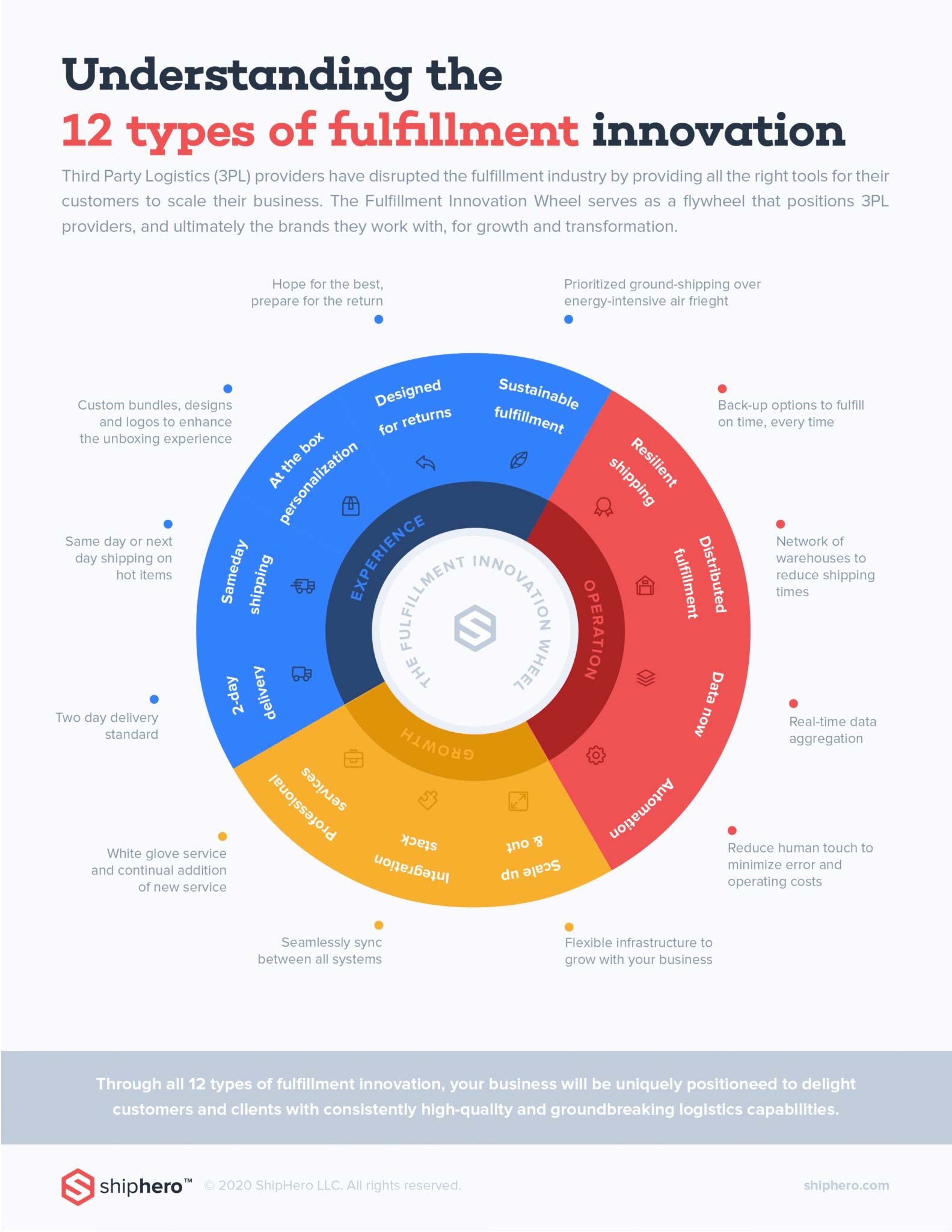
Learn more about ShipHero's industry-leading warehouse management software.
In the world of SEO, social media and online sales, the very first step to marketing your eCommerce store is simple: content creation.
From there, you can employ all the tips and tricks of boosting conversion, ranking higher with Adwords, and all that technical jazz, but it all starts with making authentic and engaging content … which also just so happens to be the most difficult to do.
In this blog series, we’ll cover all the ways your e-commerce business can start creating engaging content that tells your brand story and speaks to your audience. To start, we’ll break down one of the best ways for B2B and DTC brands to build trust and engage with your customer base: video!
In the top 100 search result listings, video appears 70% of the time. Not to mention, viewers of your product video are 64-85% more likely to purchase after watching, depending on its quality. So if you aren’t already using video, you’re not being seen.
In this article, we’ll dive into why video is the most effective tool to be seen and to be understood. Then, we’ll explain the various types of videos you can make. Finally, we’ll give you video recording guidelines to make the best possible content.
Ready? Lights, camera, action!
We know you’re here for the how-to tips, so let’s keep this brief. Simply put, leveraging video allows your business to:
The facts:
As for mobile:
The science is out there, and video is the premier way to tell your brand story, convert customers both on desktop and mobile, and increase overall engagement. So what types of videos should you be using on your e-commerce store?
There are five primary types of videos you can leverage on your e-commerce store:
Depending on your specific business and audience, try implementing some or all of the below to maximize your engagement.
When shoppers land on your website for the first time, whether through a search or ad, they immediately scour the page for what makes your brand unique from all the others. Landing Page videos are the perfect opportunity to tell the story of your brand, allowing you to use strong visuals that are worth a thousand words.
Place the Landing Page video in an easy-to-spot location with an appealing thumbnail. Most companies place the video right next to their icon or slogan for easy clicks.
Product Description videos are an important tool to convert site visitors to customers. With clear product visuals and well-articulated details, product videos are a great way to grab the attention of your visitors and deliver a complete understanding of what you sell and why.
Place the product videos right underneath product photos, or even consider substituting photos for clickable videos. The primary call-to-action for these videos should be to place items in their online shopping cart.
If a customer is interested in your product but not completely sold, they will seek out more information. Product Demonstration videos show the customer how your product is used, and how the product can interact with the world around it.
If you have a physical product, show how a customer can interact with or use the product. If it’s a software or digital product, consider screen-recording and walking through real-life use cases.
Product Demonstration videos are typically less “polished” than an advertisement and should feel like an authentic experience. E-commerce brands typically put these on YouTube and include links throughout the shopper journey.
Beyond videos produced by your company, some customers still seek a more genuine, authentic opinion. This is where User-Generated Content (UGC) allows your loyal users to share their personal experiences with your product and your brand. You may also know this as Influencer marketing, Ambassadorships, and more social media advertising.
51% of shoppers in the US say they trust UGC more than any other content on a company website, because after watching the videos, they have a better understanding of how the products work in a sincere, real setting.
Modern online retailers add UGC to their webpages to create community, and if you’re an established brand, your users will compete and have pride in appearing on your website (e.g., Nike).
Mobile Shopping videos are those optimized videos catered specifically for users watching on a smaller screen, with features built in to click and purchase directly from their mobile device.
With a specific size and aspect ratio for product videos and images, along with predetermined social media channels (e.g., Instagram Shopping), you can provide a holistic mobile-shopping experience.
Successful eCommerce retailers are able to reach large audiences with creative, shareable content, and then convert that audience into customers with a well thought out shopper journey.
Video is an important tool in both capturing your audience’s attention and giving them the information they need to make a purchase. With the above information, you are now on your way to telling a better brand story and using powerful visuals to explain your products.
Once you’ve made the sale and the customer has clicked the ‘Order’ button, what comes next? How do you get your product to your customer’s door? And if the customer needs to return your product, how do you handle it? That’s where a 3PL like ShipHero comes in, to help you simplify everything that comes after the ‘Pay Now’ button. Learn more at ShipHero.com.



.svg)