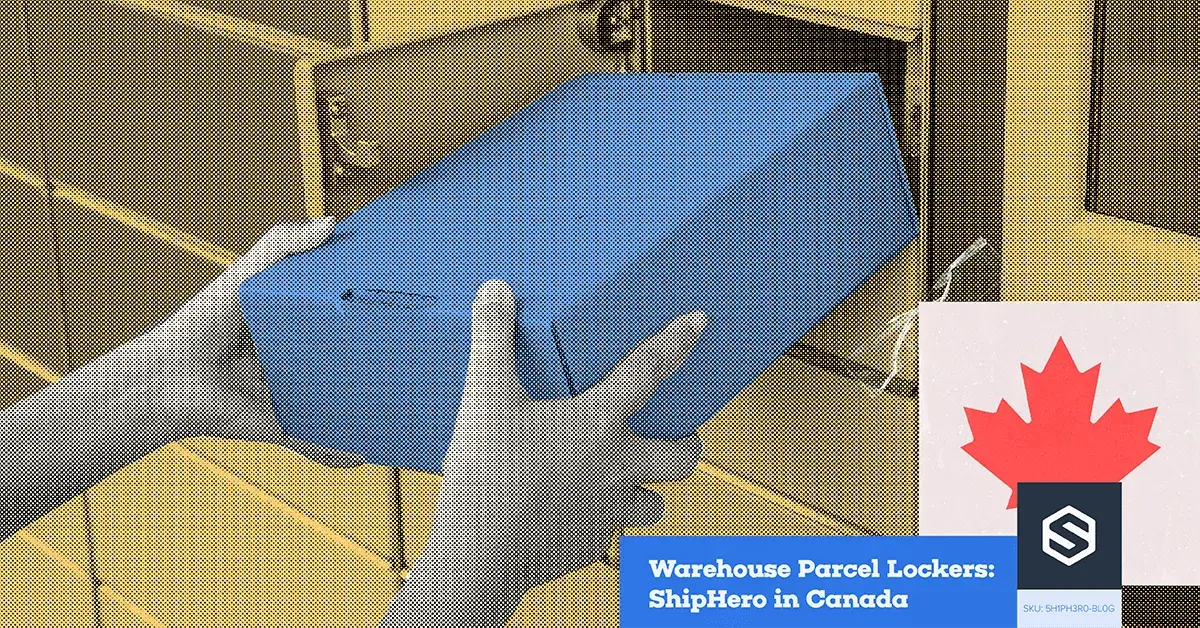

As the average person's shopping habits continue to evolve, so do the ways brands get products in their customers' hands. The eCommerce industry has exploded in recent years, with companies constantly seeking out affordable, creative and effective ways to stand out from the competition while offering a convenient buying option. The option to buy online and pick up instore, known as “BOPIS,” has allowed brands with brick-and-mortar locations to bridge the gap between their online and real-world storefronts. As BOPIS becomes more commonplace, online retailers are feeling the pressure to offer a pickup option as well. Parcel lockers, a major feature of ShipHero Fulfillment Canada, are one method of expanding delivery options and allowing customers to get their orders in the way that best suits their lives. eCommerce shippers without the advantage of a brick-and-mortar storefront can have orders placed in these easy-to-access units, making life easier on the customer while saving on last-mile shipping.
The growing popularity of in-person pickup is obvious when you consider the benefits. Let’s take a look at some of the advantages parcel lockers provide and what benefits they might have in store for your brand.
One of the major advantages of parcel lockers is the added customer convenience they provide. While in-store pickup only allows customers to collect their orders during regular business hours, parcel lockers can be accessed 24/7, allowing buyers to retrieve a package at a time that suits them best. Allowing customers to arrive at the warehouses themselves also eliminates the need for last mile shipping, one of the more expensive steps in the fulfillment process. Avoiding the cost of postage, labeling and carrier fees can mean major savings for customers, encouraging them to continue using your brand as an affordable and convenient buying option.
Outdoor storage lockers are exposed to the elements, but their contents won’t be. ShipHero Fulfillment Canada’s weatherproof outdoor locker system is designed to withstand the climate extremes of Canada, ensuring your items remain undamaged and shielded from the elements. If you’re shipping perishable items, the inside of storage lockers are temperature controlled. This provides an ideal storage solution for eGrocers that need their fulfillment partners to make sure their products are kept fresh.
One of the key expectations for customers and shippers alike is visibility. Partnering with a fulfillment 3PL that offers top-tier reporting and visibility gives you a better grasp on the progress of your shipments. That information can also be pushed to your customers, keeping them up to date on when to expect the item’s arrival.
Not only do parcel lockers make receiving orders easier for customers, but partnering businesses can also benefit from this feature. If you’re shipping component parts across Canada, for example, ShipHero Fulfillment Canada can facilitate those customers picking up the item at the time and location that works best for them. With parcel lockers as one of your brand’s delivery options, business customers can place an order online, select the dropbox nearest to them, and be automatically notified when the package is ready for pickup. Once it’s ready, those lockers are accessible 24/7.
For any eCommerce delivery strategy, visibility is key. Clear and consistent communication with the customer can minimize the risk of misships and costly returns, while supporting your buyers and giving them a reason to return in the future. When an order is placed and pushed to ShipHero, buyers and sellers are provided with a comprehensive report of the package and can track its progress as it moves throughout the fulfillment process. When a customer opts for a parcel locker pickup, they are sent a barcode and pin code that grants them access to the locker at the specified location.
Big brands aren’t the only ones that can offer a pickup delivery option. Now, thanks to parcel lockers throughout Canada, exclusively online stores can give their customers the convenience of a 24/7 pickup option. If you’re looking for a fulfillment partner to help optimize your delivery process, contact the Fulfillment Experts at ShipHero today.Click HERE to Schedule a Meeting Today
.webp)

TikTok Shop is discontinuing "seller shipping" on February 25, 2026, a move that will halt fulfillment for any 3PL using non-integrated legacy technology. ShipHero's WMS is fully integrated and approved to support TikTok Shop’s new logistics requirements, allowing you to generate compliant labels and avoid a total operational lockout. By migrating to ShipHero before the deadline, 3PLs can eliminate onboarding fees and ensure their clients’ businesses remain active and profitable.
Starting February 25, 2026, TikTok Shop is officially discontinuing "seller shipping" (also known as "bring your own label") for all U.S. local sellers.
This means your clients can no longer use their own carrier accounts for TikTok orders.
As their 3PL, you will be unable to generate labels unless your WMS is directly integrated with TikTok’s new ecosystem. To keep your clients' businesses running, you must transition them to TikTok Shop Logistics Services through a verified partner.
ShipHero can keep your 3PL orders flowing from February 25 onwards.
If you are running your warehouse on legacy systems, you are at risk of a complete TikTok Shop lockout. Your fulfillment—and your revenue—will simply stop that day.
TikTok's latest policy creates a massive bottleneck for 3PLs using legacy technology.
To help 3PLs transition quickly and stay compliant, we are waiving all onboarding fees for new customers who join ShipHero before February 25.
There are only 6 approved ERP/WMS providers globally that meet TikTok’s new integration standards. ShipHero WMS is on that list. Most legacy WMS providers are not currently approved. To avoid a total operational blackout for your clients, you must move to a verified partner like ShipHero.
No. Starting February 25, TikTok will discontinue seller shipping. All shipping must go through TikTok Shop Logistics Services.
No. You can still manage fulfillment from your own 3PL warehouse using ShipHero’s direct integration, which pulls the required TikTok labels and logic directly into your existing workflow.
You will lose the ability to generate shipping labels for any TikTok Shop order. This will result in immediate fulfillment backlogs, client dissatisfaction, and potential loss of contracts.
Yes. ShipHero is the only U.S. based WMS currently supporting these requirements, allowing 3PLs to continue shipping without interruption.
.webp)

TikTok Shop is introducing mandatory logistics changes that will stop fulfillment for unprepared sellers on February 25, 2026.
ShipHero's WMS is fully integrated and approved to support TikTok Shop’s new logistics requirements, ensuring your orders keep moving without interruption. By switching to ShipHero before the deadline, brands can maintain compliance and eliminate onboarding fees during this transition. Here’s everything brands need to know to continue fulfilling orders.
Starting February 25, 2026, TikTok Shop will discontinue "seller shipping" for all U.S. local sellers. This means you can no longer use your own carrier accounts to generate labels for TikTok orders. To stay compliant and keep selling, brands must transition to TikTok Shop Logistics Services.
Relying on legacy systems like Extensiv, Deposco, or Logiwa puts your business at risk of account suspension and shipping delays that kill customer loyalty.
If your current WMS or 3PL is not integrated with TikTok Shop Logistics Services, you will face a total fulfillment blackout on that date. Failure to adapt to these changes risks shipping delays that kill customer loyalty and can lead to account suspension on the platform.
For brands onboarding on or after February 9, 2026, these restrictions are already in effect.
ShipHero has done the due diligence and has built a direct integration to ensure that merchants can fulfill TikTok Shop orders themselves while remaining fully compliant with TikTok’s new label requirements.
To help brands and 3PLs transition quickly and stay compliant, we are waiving all onboarding fees for new customers who join ShipHero before February 25.
Currently, there are only 6 approved ERP/WMS providers globally that meet TikTok’s new integration standards. ShipHero WMS is on that list. If you are using legacy providers like Extensiv, Deposco, or Logiwa, they are not currently approved to support these specific TikTok Shop requirements. To avoid a total operational blackout, you must move to a verified partner like ShipHero before the deadline.
No. Starting February 25, TikTok will discontinue seller shipping. You must use TikTok Shop Logistics Services.
You can use Fulfilled by TikTok (FBT) to store and ship items through their network, switch to one of the six approved ERP/WMS systems, or use ShipHero's direct integration.
You must use TikTok Shop Logistics Services, but with ShipHero, you can still manage the fulfillment from your own warehouse using TikTok’s required labels and logic.
This connection type will not support the new label requirements. You must switch to a direct TikTok Shop connection within ShipHero to avoid fulfillment interruptions.
Yes. ShipHero is currently the only U.S. based WMS that supports these requirements, allowing our customers to continue shipping without interruption.
.webp)
Imagine running a warehouse where orders are picked quickly, inventory is accurate, and all operations run smoothly without any errors or delays. Thanks to Artificial Intelligence, this can now become a reality with ease.
AI is transforming warehouse management by enhancing efficiency, intelligence, and the ability to meet the rapid demands of today’s eCommerce-driven market.
ShipHero is pioneering this revolution with its AI-powered warehouse solutions, setting new industry benchmarks. This article explores ShipHero’s AI Picking feature, highlighting how it’s transforming warehouse management and enhancing operational efficiency.
The integration of AI technologies, including machine learning, robotics, and predictive analytics, is revolutionizing warehouse operations, driving significant improvements in efficiency, accuracy, and overall performance. These innovations are optimizing processes across various areas, from inventory management to order fulfillment. Below are the key benefits of AI in warehouse management.
A combination of AI technologies is shaping smarter warehouse systems to help revolutionize warehouse management.
ShipHero has taken AI integration to the next level with its AI Picking feature, designed to significantly improve warehouse efficiency. This feature automates the picking process, reducing the reliance on manual labor and enhancing productivity in ways that were once thought impossible.
Let’s dive deeper into how ShipHero’s AI Picking works and the advantages it offers.
AI Picking optimizes warehouse operations in two key ways:
The AI Picking feature delivers a wide range of benefits:
The transformative power of AI extends far beyond just picking. AI is also revolutionizing other aspects of warehouse management, driving improvements in operational efficiency, inventory management, and safety.
AI automates tasks, reducing errors and increasing speed. Automated sorting and real-time inventory tracking ensure accuracy, while real-time monitoring helps managers adapt and ensure timely deliveries.
AI plays a vital role in maintaining accurate inventory levels. By leveraging predictive analytics, AI can forecast demand and optimize stock levels, helping warehouses avoid both stockouts and overstock situations. This leads to better inventory management and fewer disruptions in supply chains.
AI-driven systems can monitor warehouse conditions to ensure safety and compliance with industry regulations. These systems can analyze warehouse data and predict potential hazards before they occur, proactively reducing risks and ensuring a safer working environment.
AI technologies are playing a transformative role in the supply chain and logistics sectors by improving efficiency, reducing costs, and enhancing decision-making.
These intelligent systems effortlessly manage supply chain processes by using data to optimize operations, predict trends, and automate routine tasks. This ultimately reshapes everything, from how goods are moved to stored and delivered.
The future of warehouse management looks promising with greater automation and efficiency, but future warehouse digitization brings challenges, such as high upfront costs and the need for skilled personnel.
AI-powered drones, autonomous robots, and IoT integration are smart warehouse technologies that are revolutionizing warehouse operations. Drones will deliver goods quickly, while robots automate sorting and transportation, thereby reducing the need for manual labor.
IoT and AI integration will enable real-time monitoring and optimization of operations. Smart technology in warehouses is leading to fully automated systems that are faster, scalable, and need minimal human input.
While AI offers immense benefits, businesses must also consider certain challenges. High initial investments in AI technology, data security concerns, and the need for skilled personnel are just a few of the hurdles that must be addressed.
However, with a strategic approach, companies can eliminate the challenges and embrace AI’s full potential to boost accuracy in picking and improve overall warehouse operations.
AI minimizes error by automating tasks like inventory tracking, order picking, and sorting, ensuring greater accuracy and efficiency.
Yes, AI-driven predictive analytics can predict demand, track inventory levels, and improve supply chain efficiency by forecasting needs with greater accuracy to help businesses stay ahead of trends and market fluctuations.
AI solutions are becoming more cost-effective thanks to cloud-based services and subscription pricing models. These options make AI technology more accessible to small businesses, allowing them to take advantage of its benefits without large upfront costs.